| Boker Joule |
| I'm pointing to the partially engaged frame lock |
| Fixed!?! |
What’s your life game? I discovered long ago my life plan involves knives. Folding knives, fixed blades, pocket knives, survival knives, tactical knives, it doesn’t matter to me. As long as it has an edge, I’m interested. Join me as I write about life, knives and the things seen from the knife edge.
| Boker Joule |
| I'm pointing to the partially engaged frame lock |
| Fixed!?! |
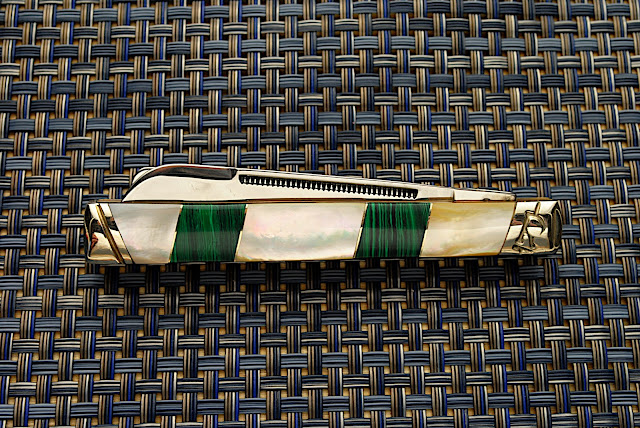
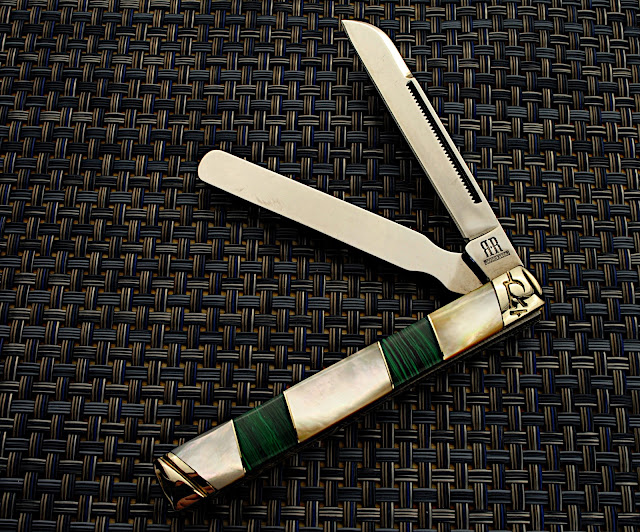
I'm a big fan of doctor or physician knives. They usually come with a spear point blade and a spatula. The knife butt, on the best of them, is a solid flat end cap used to grind medications and materials. There was a time when doctors would make house calls, especially in the more remote parts of the country. Sometimes they need to open their black bag and formulate medication by absorbing a liquid into a solid and solids to ointments. This called for a spatula and a way of grinding materials. Hence the doctor’s knife.
| Rough Ryder's Doctor Knife |
“…this was entirely done by hand. The pill mass was rolled into the form of a cylinder, placed on a graduated tile and divided by means of a spatula into measured lengths calculated to contain the required amount of active ingredients. These were then rounded between finger and thumb to give the final product.” Hong Kong Medical Journal 2015.
Of course, the blade was needed
to lance boils and carbuncles. Medicine
in the early 1900s was not for the faint of heart.
I’ve always been fascinated with
spatulas. As a chemist, I used a variety
of sizes to weigh out chemicals and unknowns.
Then I turn around and see a chocolate maker use the same tool. Take a step and you’ll find printers keeping
the ink in the printing bank mixed and evenly spread out with spatulas. You’ll find them in kitchens, paint and
pigment stores, in labs and pharmacies, but you’ll seldom find them with
doctors.
I don’t see too many doctor
knives around, especially the older ones, so I was happy to find one from Rough
Ryder. Yes, they changed their name from
Rider to Ryder. I don’t know if it was
the condom association or Teddy Roosevelt.
Perhaps the change was just a public relations move to get more notice.
| I think of that blade as more of a sheep foot blade, but there is a high degree of freedom in naming blades |
The knife is 3.6 inches closed and has nickel silver bolsters. It has a spey blade and the traditional spatula. The handle is malachite and pearl from Stoneworx. The knife has brass liners and the two blades are separated by brass as well.
All and all, it is a really nice
doctor’s knife and I really like it.
Rough Ryder has an upscale group of knives, and this is one of
them. It is a nice example of knife art at a reasonable price. You can buy one for the princely
sum of $26.00.
I hope you enjoy it as much as I do!
I finally got around to breaking out and using Artisan Cutlery’s Sea Snake.
| Artisan Cutlery's Sea Snake |
I came across it at the 2021 Blade Show and it followed me
home. I’m sorry I waited so long to
break it out.
Artisan Cutlery is a Chinese company making innovated blades as well as using interesting steels. My Sea Snake was crafted from AR-RPM9, a proprietary powdered metal steel.
The formulation?
Well, it’s proprietary, but few compositional secrets remain secret for
long. Here’s what I found on the
Internet:
0.9% Carbon,
18% Chromium,
1.0% Molybdenum,
0.45% Manganese,
0.1% Vanadium,
0.30% Cobalt,
0.2-0.8% Silicon,
less than 0.40% Nickle,
less than 0.05% Rare Earth.
I’ve never seen anyone list or express concern about rare
earth composition.
Chemical analysis can tell you what’s in a product, but not
necessarily how it performs. Looking at
these numbers, I could do this analysis with a half decent SEM and EDS. There are no significant elements below 0.1%. But like Coca-Cola, it’s how it’s cooked that
makes the difference. That would take some
real research into metallography to unwrap those secrets.
In any case, enjoy this steel, because I am.
The 3.15 inch flat ground Wharncliffe blade is fixed to a
G-10 clad handle giving the knife a total length of 6.78 inches long. The blade has a RHc value of 59-61.
I like the feel of the knife in my hand and I can’t stop
playing with it. The balance point is
back in the handle and the finger groove provides plenty of grip and prevents
you from sliding onto the blade. That’s
always important to me. There is a
secondary finger groove carved into the blade shortening the actual cutting
edge to just under 2.5 inches. Using the
two finger grooves and the jimping on the blade’s spine locks the knife in my
hand and gives me fine control over the blade.
The knife is designed by Mike Embler. Mike is from eastern Ohio and spent 18 years
in the Navy. He studied multiple forms of self-defense,
including Japanese swordsmanship while stationed in Japan. This helped shape his views on knives as
tools and weapons. It was in Japan he
discovered the joys of flat grinds.
You should keep an eye out for him, I think you’ll be
seeing more of his work.
| Dressed up and ready for a night out. |
I got the green G-10 handled knife in the khaki green sheath. It seemed like the right color for a Sea Snake. But the black para cord it came with was the pits. Not content with that, I dug out some woodland camo paracord and found an almost matching green and orange glass bead and dressed up the sheath.
Neck knives are becoming a fashion accessory for men; women
too!
Yes, I know they started out as a hidden weapon, worn under
a shirt or blouse, a tool of last resort, likely to be missed in a fast
pat-down. But really, those days are
gone. Everyone checks around the collar for
the tell-tale cord, pats the chest and under the arms. Then there’s the metal detecting wand. Just wear it as a fashion accessory.
Besides do you really want to go into combat with an
unbreakable noose around your neck?
You can get you’re Sea Snake at https://www.artisancutlery.net/sea-snake-atz-1842b-g10-ar-rpm9?search=sea%20sNAKE&description=true
for $39.98. They currently have a
limited issue made with S35vn steel and another with a carbon fiber handle at
prices reflecting the more exotic materials.
| Gerber Parabellum: Prepare for war |
The Gerber Knife Company has a funny origin story. It’s not secret but I find it amusing. It's not about making knives, it's about selling knives.
It’s
1939, Hitler fires the opening shots of WWII.
A few Americans are concerned.
Leo Szilard and Albert Einstein draft a letter to President Roosevelt about
the potential to build an atomic bomb and advising him to create and fund a
government research project on nuclear weapons.
Joe
Gerber owns an advertising agency in Portland Oregon that has been in his
family since 1904. Christmas is coming
and Joe wants to give special presents to his best customers. He has David Murphy, a local knifemaker,
craft 24 knives.
Somewhere,
somehow Abercrombie and Fitch get their corporate hands on one and they want to
sell them.
Joe,
knowing advertising and business, starts Gerber Legendary Blades by ordering
more knives from David. Eventually David
and Joe separate and my source claims David Murphy, despite his fame, dies
bankrupt.
Over
the years Gerber has employed craftsmen who went out and established names for
themselves. Both Pete Kershaw and Al Mar
left and started their own companies.
It
is reasonable to say Gerber started the knife business in Oregon. Over the years Gerber bought knife designs
from a list of Who’s-who in the knife industry.
The list includes Bob Loveless, Blackie Collins, Fred Carter, Ernest
Emerson, Bear Grylls, and local hero Rick Hinderer.
| The Parabellum is not a pocket size knife |
In
1987 the Finnish company Fiskars bought Gerber Legendary Blades. Fiskars is essentially a holding company whose
main business concern is owning significant portions of other profitable
companies. Fiskars also owns the classic
British company, Waterford Wedgewood, who is themselves a holding company. Let’s not go down that rabbit hole.
From
1987 to 1994 Gerber made the Parabellum aka Black Bolt. It was engineered to be one of the stoutest
folding knives ever made. And if you
ever handled one, you would believe it.
It is reported that Blackie Collin designed the Bolt Action, the mechanism used to lock the knife open.
It takes a little force to unlock the blade. That isn’t always a bad thing.
I
ran into this one and despite the shadow on the back of the blade I bought
it. The edge looks factory and it comes
with the duty belt clip. The pouch can
be reconfigured so the Parabellum can be slipped into it with the blade open like
a sheath knife.
| Discoloration on back of blade |
The 4-inch flat grind drop point blade is over an inch and a quarter at the widest point and 11/64 of an inch thick. The steel is probably 440C, the best of the 400 series. At the time 440C was premium mid-level steel for knife making.
440C
stainless contains:
C 0.95-1.2%
Cr 16-18%
Mn and Si at
1% each,
Mo 0.75%
The steel is magnetic so keep it away from your compass
if you’re navigating by map and compass.
| Gerber Parabellum and original sheath |
I think my Parabellum was carried and never used. The pouch shows a little rust on the back
snap and the cover snap seems to have been thumb polished. The discoloration on the back of the blade appears
to be confined chiefly to the portion of the blade not protected by the knife
handle. The handle itself doesn’t have a
mark or scratch on it.
| Back of Sheath It can be unsnapped and rotated to a drop leg sheath to hold the open knife |
I’m going to leave it the way it is.
I find myself window shopping in the Böker catalog. It’s the adult version of creating a wish list for Santa. Since I’m just window shopping, price becomes irrelevant. Grab a shopping cart and come with me.
![]() |
| Böker 98K with those interesting handle grooves |
I like working blades. Knives that I’m going to carry and use and surprisingly they don’t all have to be tactical blades. I really like the Böker 98K Damascus modestly priced at $419.00. The blade is made from portions of the German Karabiner 98K, best known for its Mauser locking system. Chad Nichols changes it into a ripple pattern Damascus blade.
The clip point blade uses a nail nick to open and the handle scales are walnut wood. The knife has a protruding back lock and steel liners for strength. https://www.bokerusa.com/98k-damascus-110715dam
![]() |
| Swiss Dagger |
![]() |
| Boker has a simple, working pikeman version too. |
It’s not available at Böker anymore, but you can find it at… Well I’m wrong, actually nobody has it here in the States. It does seem available at the German Böker website.
![]() |
| I suspect it should be called Glamping, not camping. |
![]() |
| Your basic scout knife |
https://www.bokerusa.com/camp-knife-stag-110182hh
![]() |
| What can I say, I have permission to use Boker's website images. |
Lastly, I’d want a Böker plus Nori CF. It a thin streamline folder with carbon scales designed by Kansei Matsuno. It’s a gentleman’s knife with a pocket clip and a subtle front flipper. The 3.15 inch blade is completely submerged in the handle and it weighs in at 1.6 ounces.
![]() |
| A little nicer look at the carbon fiber handle |
https://www.bokerusa.com/nori-cf-01bo891?number=01BO891
Ladies
did I forget you? No, I didn’t.

Damascus is hot this year. The auto kwaiken has very good looks, especial with the abalone button
Böker makes a lovely auto knife perfect for elegant wear. It’s a Damascus kwaiken with a 3.5 inch Chad Nichols virus pattern blade in a black handle weighting 3.4 ounces. The activation button is inlayed with abalone. It is very nice and expensive at $650, but you’re worth it, aren’t you? At least I think so. Unfortunately, it isn’t quite available yet.
https://www.bokerusa.com/kwaiken-automatic-damascus-06ex293dam
There
no sense leaving post-it notes on the pages.
My wife just throws her hands up and says, “You want it? Order it.
Don’t make me a party to your edge lust!” It’s a thought, but I’d rather window shop. There is always a nicer one out there.
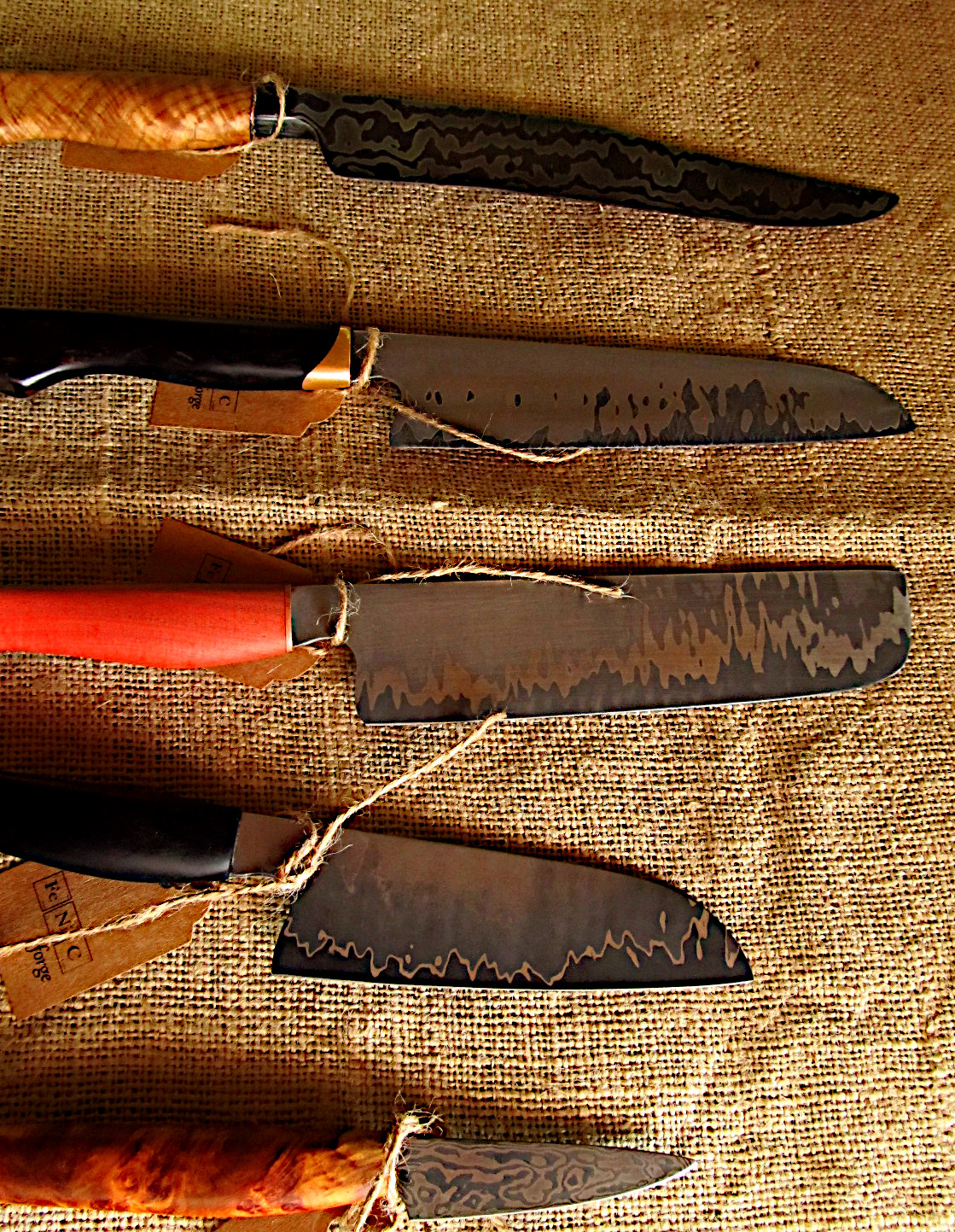
I ran in to a young man who is just starting to make knives. For the last two years he’s hammered, removed stock, taken classes, sharpened edges and dropped a lot of sweat on the ground. Why? Because David Pienta wants to be a master knife maker. But the road is long and twisty and not everyone makes it, but he’s starting. Right now he’s working with stainless Damascus steel he hammer forges himself.
I bought the one on the bottom
The name of his forge? Fenic Forge. The name derives from the chemical symbols for iron, nickel and carbon, important elements in steel. He doesn’t have a tang stamp yet and I urged him to. Many of his knives are objet d'art and without a tang stamp their value will be less. I’ve handled too many nice knives that everyone simply shrugged and said “Beats me who made it or what it is worth?”
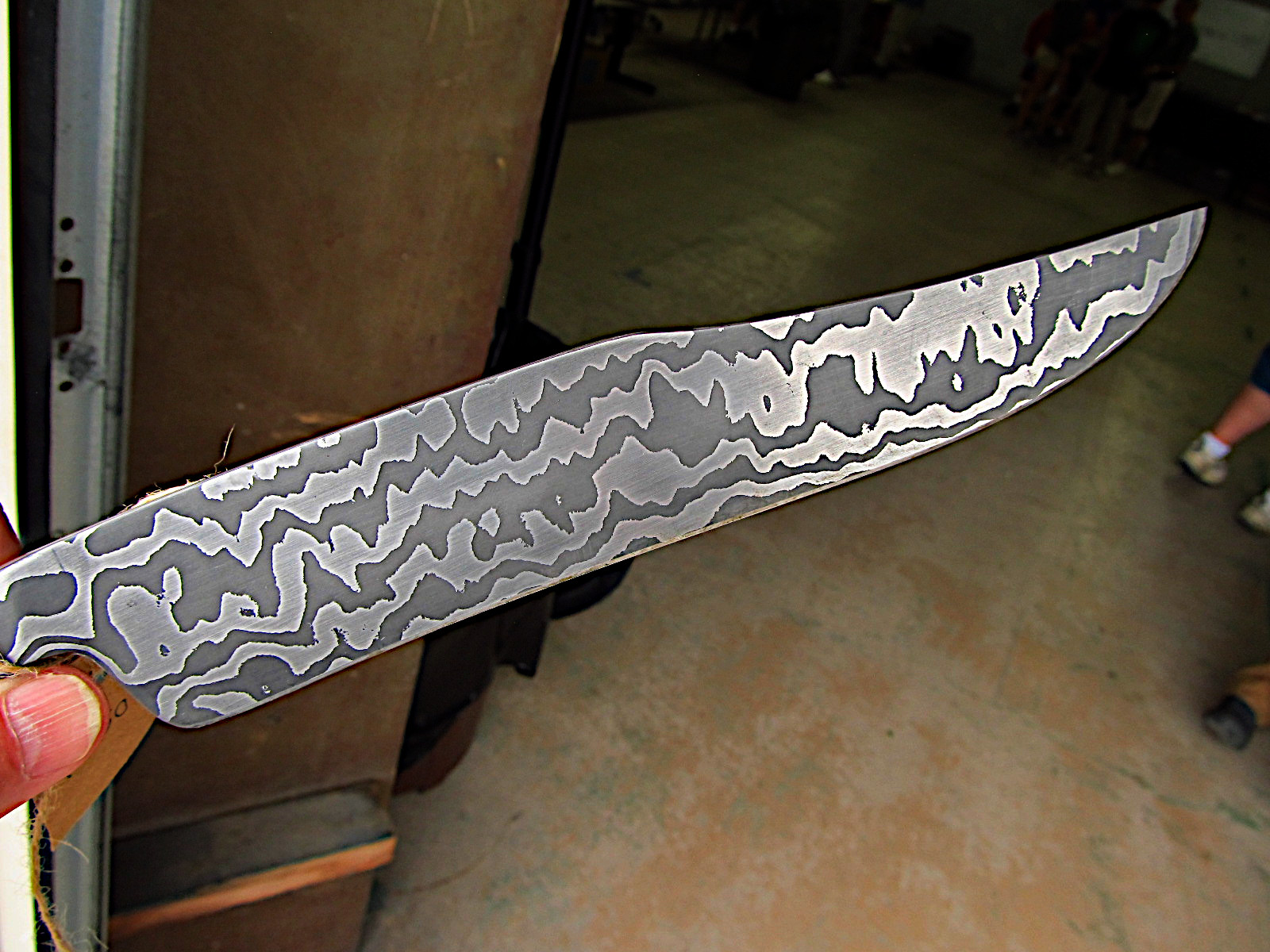
| Bold Tiger Stripe Damascus |
We disagreed on the artistic nature of his stainless Damascus choppers. He thinks they are practical Choppers. Perhaps. I think you will not see too many Damascus knives as choppers. Yes, I know the maker has the edge on what he thinks his knives are for, but it is really up to the consumer.
I bought a small kitchen utility
knife, maybe seven layers of steel in an exotic burl handle. The handle has
good symmetry and the blade has nice lines for a small working knife. The small number of layers allows the differences
in steel to be bold statements. The working
edge ends with a gap between the steel blade and the handle. I like the way my finger sits in that place,
so clearly defined with no worries of sliding onto the blade.
| My kitchen utility knife |
I’m going to sharpen it bit more and treat the handle to a good wax coating and Karen will have a special kitchen knife.
You can find David on Instagram
or http://fenicforge.com/.
It’s not stainless. In fact a product insert warns you to protect the blade.
Bohler-Uddeholm list the following reasons to use their K390 Microclean steel:
The Chemistry also looks interesting.
I should also note, new steels aren’t simply made by dumping elements together. Tempering, stress relief and hardening cycles have a major part in any production metal. Still, I find these numbers amazing, especially the 9% vanadium and 2.4% carbon!
Strictly speaking chromium levels should be around 11% to be classified as stainless. Chromium forms carbides that stabilize the microstructure, so in ordinary steels you need an excess of chromium to react with carbon and still have enough to protect against rust. Here you have vanadium to form carbides. So is there enough chromium to form the transparent chromium oxide barrier? I don’t know.
Let’s play.
I’ve been cutting cardboard all week, I haven’t noticed any loss of sharpness. Today I cubed semi-frozen beef for a future chili dinner. I thought the knife handled better than many of the larger chefs’ knives or the smaller utility knives. I sliced up some lemons and limes for summer drinks and the knife worked fine.I think the K390 steel is going to be a winner. I haven’t had to sharpen it yet, but I have no doubt my Spyderco Sharpmaker is up to the job. I understand you’re going to see K390 steel in a lot of other Spyderco products. I also think you’re going to like it.