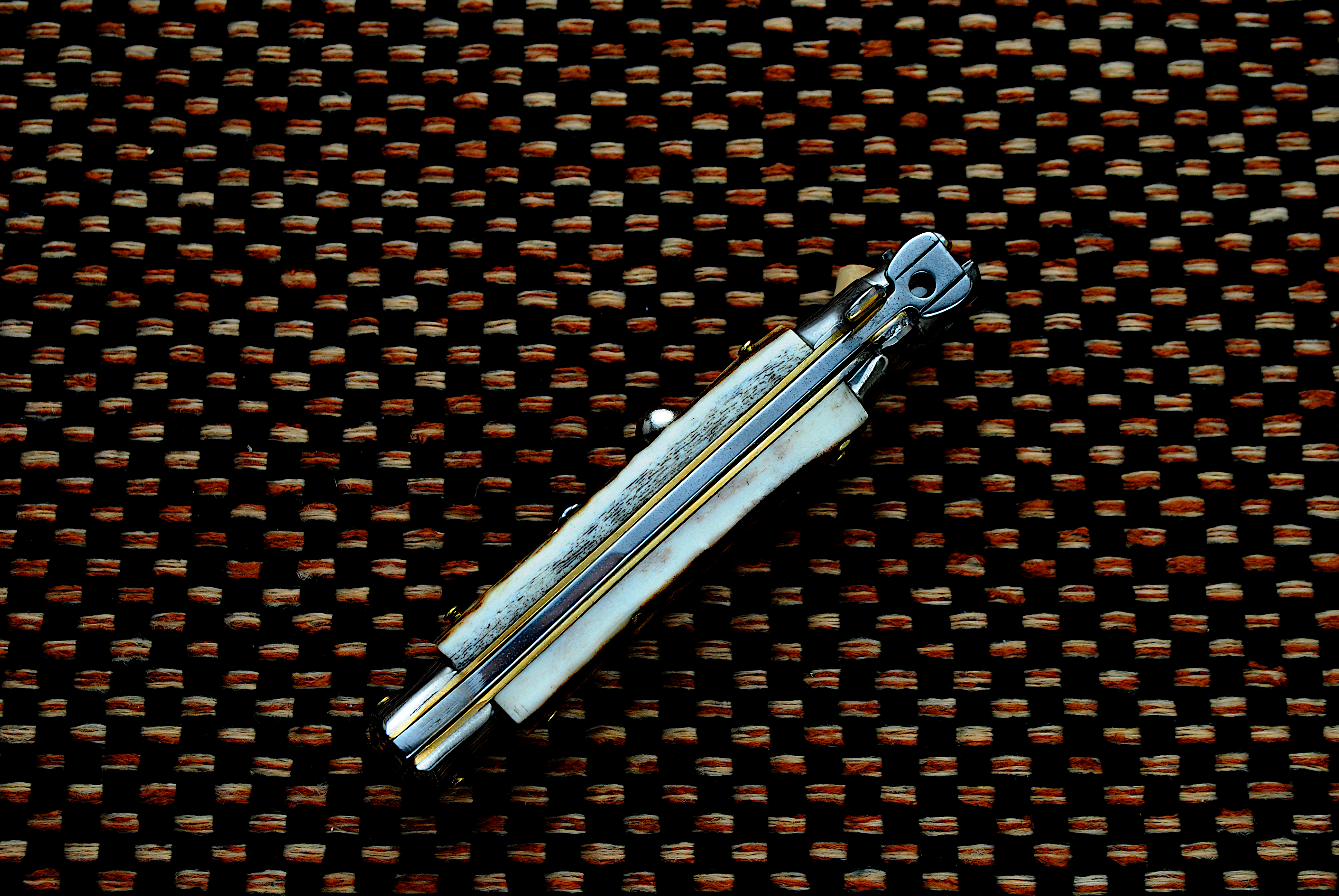
Tuesday, February 11, 2025

Vosteed Corgi


Last year at the Blade Show, I noticed the Corgi Trek at Vosteed Knife.  I was struck by the size, shape, and interesting opening mechanism. 

Vosteed Corgi

First, a little about Vosteed Knife.  Vosteed was started in 2021 by Johnny and Yue Dong.  The plant is located in China.  They work with several international designers like Geoff Blauvelt and Ray Laconico, to name a few.  The mission statement declares, “Honesty is a core business value.”  I have always found the best knife companies have simple, understandable statements about fundamental values.

Yue Dong is the in-house designer responsible for the Teck Lock on Corgi knives. 

I like Vosteed Knife.  I spent more than a bit of money at their booth at 2024 Blade. 

This Corgi has a sheepsfoot blade with a high shoulder grind and reverse tanto point.  The complex angles where the tanto meets the spine give the blade an eye-candy look. 

The sub-three-inch blade is made from 14C28N steel hardened to a RHc of 60.  This steel has been a favorite compared to S30V, VG-10, and AEB-L, all quality knife steels.  Let's briefly look at the chemistry.  14C28N steel can vary depending on the manufacturer, but it generally contains:

14% Chromium: Provides corrosion resistance and hardness,

0.6% Carbon: Increases hardness and wear resistance,

0.3% Nitrogen: Improves hardness and corrosion resistance,

0.3% Manganese: Improves hardenability and wear resistance,

and trace amounts of Silicon, Phosphorus, and Sulfur.  The last three improve machinability.

14C28N steel has excellent edge retention and improved hardness due to the nitrogen content.  More than one reviewer thinks it's a great choice for tasks that require a sharp edge, like cutting and slicing.

The levels of chromium provide good resistance to rust resistance and other forms of corrosion.  I have a knife that I accidentally ‘patinaed’ by slicing lemons.  Don’t laugh, it could happen to you.

the reversible clip


The blade is housed in a reinforced frame with a blue-gray micarta handle.  The knife comes with a deep carry clip for right-side, tip-up carry.  The clip is reversible.  You can't help but notice the depression that takes the clips has a metal plug filling it.  It gives the knife a look of completeness.  It's something you don't see on many higher-end knives.

Opening flippers


The knife opener is called “front and back flippers."  The flippers have a bit of gimping for friction, and you open the knife by pressing down on the ear.  The blade glides open on caged ceramic ball bearings.  This is high-tech stuff.

A little pressure on the opening tab and the Corgi flies open


Ceramic ball bearings have high hardness and elastic modulus.  No, that's not techno-babble; it means the bearings resist deformation under load and have increased wear and corrosion resistance.  They can run lubricant-free.  If you must rinse the knife out and can't re-oil it, the bearings have your back.  

There is a downside.  Ceramic bearings are sensitive to thermal shock and have lower load capacities.  These aren't really problems for knives.

Time for a true confession.  I don't sell knives from my blog, and I don't own this Corgi.  I know it feels good in my hand, but I’m not about to use someone else's knife in cutting tests.  On the Vosteed website, I noticed that their current stock was low.  What will the proposed trade tariffs affect?    I don't know.

If you're looking for one, I'd act sooner than later.

Friday, January 31, 2025

My Spyderco - Part 2


Spyderco  Part 2

C179 - Spy-DK

Many European countries and American cities prohibit knives that lock open.  As irrational as it is, the view claims a non-locking knife is less dangerous than a locking knife.  I don’t know.  It is hard to believe a stabbing or slashing wound is less serious if it is from a non-locking or slip joint. 

Spyderco  Spy-DK

The Spy-DK is based on the UK Penknife, with its blade length reduced to comply with Danish law.  The 68 mm flat grind blade is made from Böhler-Uddeholm’s premium N690Co stainless steel.  N690Co is similar to 440C but with increased levels of molybdenum and cobalt.  It has excellent resistance to corrosion, even in acid media, and high impact strength.  The downside seems to be a slightly reduced edge retention.

The Spy-DK has Spyderco's trademark round hole, but the hole is purposely small to prevent one-handed opening methods.  Following that theme, a powerful spring holds the blade firmly closed and precludes a one-handed opening.  Closing this knife is an adventure in injury as it requires significant force to close it.  This difficulty in closing may be why the knife was only manufactured from May 2014 to Nov 2016.

The Spy-DK’s handle is injection-molded fiberglass-reinforced-nylon (FRN) scales with fine square checkering.  Interestingly, the bottom of the blade’s choil is jimped to provide a friction surface to keep your index finger from sliding onto the sharp blade.  The form of the handle almost forces you to use that grip.  I don't like it; it makes me feel like I will slice my finger open.

The front of the tang is stamped Spyderco, N690CO, and the reverse is marked Maniago, Italy.  The back of the blade is marked with Sal Glesser’s trademark, a stylized SAL.

The question in my mind is, is the knife a winner?  As an American living in a relatively knife-restriction-free community, I would say no.  Still, that is not really a question for a collector.  Our question to you is, "Do you have one? 

C65BLP - Blue Lum

My first Spyderco Lum Chinese folder was green-handled, and I liked it so much I stopped carrying it and made it a safe queen. 

What’s a Lum Chinese folder? 

You really need to get out more.


Spyderco Lum Chinese Folder  You can see Bob's name and chop next to the thumb hole

Bob Lum was 3rd generation Chinese born in Astoria, Oregon, USA, in 1943.  As a keen fisherman and hunter, he honed ideas about knife design.  In 1976, Bob began making knives and took the world by store.  He worked with Spyderco, Benchmade, and Seki-Cut, as well as in the custom field.  He is credited with introducing the Tanto-style blade to America.  Bob passed in 2007.  His Spyderco Chinese folder is perhaps the loveliest knife I own.

The C65 Bob Lum Chinese folder’s blade is tapered like a broad, flat leaf made of VG-10 sporting Bob Lum’s Chop and last name.  VG-10 is a Japanese super-steel developed for the horticulture industry by Takefu.  It is a favorite of Japanese chefs. 

The leaf shape pays homage to Bob’s cultural background.  It has been around in China for centuries.  It’s a definite winner for general utility and hunting.  The lack of a guard limits its tactical value.

While I have a green one, I was fortunate to get a C65BLP.  That’s a blue Almite coated Chinese folder made in the early months of 2002.  It is reported that only 800 to 1000 were made.  Spyderco has a buyer’s club.  It’s limited to 999 members.  Here’s the inside: You must buy every new knife they produce that year, with no exceptions.  The blade comes stamped with your three-digit number.  What you do with your knife is your business.

My Lum came stamped with 071V.  The V signifies variation.  Several variations have been reported, and perhaps the rarest is a cranberry Almite prototype.  Does it actually exist?  I don’t know. 

SC01PS - SpyderCard

Perhaps the most intriguing Spyderco is the SC01, the SpyderCard.  Eduard Bradichansky designed only two knives for Spyderco.  One is part of their ethnic series, and the other is the SpyderCard.  You can read more about the Spydercard and Bradichansky at https://knifesearch.blogspot.com/2016/04/spyderco-spydercard.html.

SpyderCard -  Don't leave home without it

The Spydercard first came to my attention at the 2000 Shot Show.  The knife is a full-sized folding knife with similar dimensions to a credit card.  It is about the thickness of three credit cards, but does fit in your wallet.  I’ve always believed it was an attempt to hide a cutting tool in the wallet of potential hostages.  Considering Bradichansky death in a terrorist attack on the West Bank, Israel, it is not surprising his design tended in that direction.  I also think if he had not been killed, he would have refined and matured his design.

The SpyderCard came with a plane or a partial serration.  The blade is crafted from AUS-6.  I prefer the cutting power of serrations on a small blade like this.

AUS-6 is stainless steel by Aichi Steel Corp. similar to 440A.  You used to see this steel in the introduction of knife market models because it is easy to sharpen and has excellent corrosion resistance.

SpyderCard - Open with 50/50 blade

Mine is from 2002 and has what Spyderco called a 50/50 edge.  I think of it as partially serrated.  The hole in the handle isn't the Spyderco trademark, it's designed to give you access to the integral lock.

It’s a very cool and perhaps a bit impractical knife.  Make sure you don’t have it in your wallet if traveling by plane for two reasons.  One, it will literally make the TSA agent’s head explode, and two, you’ll lose an interesting knife.

C11ZFGYBLP - Delica Zome


Delica Zome Blue Gray

The last knife tonight is a sprint run.  It’s the C11ZFYBLP or, as I know it, the Delica Zome Blue Gray.  Knife Magazine published a delightful article about this knife in the July 2023 issue. 

Sprint run knives are a unique manufacturing lot of established knives with different steels, often with hard-to-work steels, handle materials, and colors.  In many respects, Spyderco is a small custom shop experimenting with novel steels, constructions, and processes.  From a selling point of view, Spyderco is a little like Case knife: you'll never collect a sample of all the variations.

Sprint runs are always in limited quantities and sell out quickly.  You usually must buy almost as soon as you see the advertisement.  There is quite a following for sprint runs.  The Zome has a laminated blade with SuperBlue steel sandwiched between two slabs of SUS410.

If you look careful, you can see the differential polishing line in the blade

A laminated steel blade was the answer the ancient knife makers discovered to an old problem.  High-quality steel was never abundant, and while it held an edge, it was brittle.  Softer steel (steel is a mixture of iron and carbon) was flexible and stood up to hard use but couldn't hold an edge.  But laminate the hard steel in a sandwich of soft, flexible steel, and you have a winner. 

The FRN handle is a blue-gray polymer which is hand-dyed to produce color splotches reminiscent of Japanese Ai Zome, a fabric coloration process.

Delicas are one of my favorite knives and the flat grind blades, like this one, have amazing cutting properties. 


More to come!


 Part three

Wednesday, January 29, 2025

Swimming With The Dolphin

Collecting factory knives is the definition of jumping down the rabbit hole.

I recently obtained a 7-inch switchblade with a tang stamp ‘Dolphin D.M.’ I checked the few hard copy resources I have, but they were of little or no help.

My newest auto


Where does one go when you need information?

I used to go to public or university libraries, but in today's world, you try the Internet. It was quickly revealed that the company is called Dolphin D.M. and is in Maniago, Italy.  Oh!

Well defined tang stamp,  Note the meaning on the pivot 

I think of Maniago as a factory city. Orders for cutlery are spread out into the community, and different cutlers make knives to a general specification. Every cutler does it differently, so knives might be slightly different in length or with a different finish. The blades are stamped the same, and Bang!  Bob's your uncle!

Speaking of Bob, I want to thank my friend Bob for his insights on Italian switchblades.

Locking tab and blade stud


Dolphin D.M. is the brainchild of two men, Francesco Mariani and Lucio DeBon. Lucio DeBon is the acknowledged expert on natural scales in Maniago, and he is patronized by all the local makers.

The tang stamp has two dolphins, DeBon is the larger of the two. He has hand-selected the scale material used by all the shops making Dolphin D.M. By now you should be guessing that DeBon is the D. in the logo.

Francesco Mariani, I'm told, is the marketing guy at Dolphin D.M. He is the little dolphin on the tank stamp and the M in the logo.

But who actually made the knife? Here's the rub. You must guess based on workmanship. Francesco Mariani Dolphin's website states, "We collaborate with some of the most talented Italian master knife makers, including Renzo Pascotto, Giovanni Beltrame, Lelle Floris and many others."


5-pin back    Lovely stag, isn't it?

The locking hole is round and doesn't go through the ricasso. That eliminates some makers. The back of the knife has five brass pins, which I'm told is special. It is a picklock (the slang term 'pickle' sent me in circles for a while), and the ears are solid. The brass frame is continuous and follows the ears, but you can see machine marks and slight overgrind. The foot or J at the end of the back spring shows heavy grind marks.

Grind marks... I can't help wonder if 30 seconds more work would have eliminated the marks and increased the value?  


 The ones I see on the Internet read Made in Italy   Note the open "O" in Maniago

The stag scales are beyond lovely, and they should be as they were hand-selected by Lucio DeBon.


I like the deep color on quality stag

The tang stamp is interesting. All the internet images I could find read, 'Made in Italy,' not 'Maniago Italy' with an open 'O' resembling a backward 'C.' I'm unable to determine when that was changed. I'm told the company started in October 2023, and my knife resembles what was made in the fall of 2024.

The knife has minor pocket wear, and of course, the blade is dull enough to be considered unsharpened, a common feature of many Italian switchblades. I'm delighted with it. It's a nice little knife that fits in my small collection well.

The question everyone wonders about, with good reason, is, "What's it worth?" Did I get a deal or taken to the cleaners? You know the answer if you have been in the collecting market for long. It's worth what the last person paid for it.  What you paid for it.


Tuesday, January 14, 2025

Taking Care of Business

            You come to own a few knives, maybe more than a few, you'll discover you’re a knife collector.  Smart knife fanciers know they need to take care of their investments.

Every folder needs a drop of oil in its pivot, spring, or release.  The same goes for any metal blade.  Maybe your blade is a super stainless, or perhaps it is a nice 1085 carbon steel, but it still needs a drop of oil.  Stainless steels are literally called stain-less because they are more resistant to rust, not impervious.

These are all non-food grade

There is a sub-class of collectors that like to corrode their blades.  They say they are adding a patina.  I've heard collectors claim they like the patina older carbon blades form. 

No matter what you call it, it’s corrosion/oxidation.  Most corrosion is rust; to prevent it, we need to keep the steel dry and protected.  The easiest protection is oil.

But what oil?

As Rhett told Scarlet, "Frankly my dear, I don't give a damn."  Almost any oil, 3 in 1, some high-tech silicone or mystic rendered unicorn horn will work.  The better question is, which will harm my knife?  And which ones are safe for food?

A few years ago, everyone was excited about a mixture of hexane and paraffin wax.  The hexane would evaporate, leaving a thin coating of wax behind.  This product was often found lubricating bicycle chains.  The wax didn’t attract and hold dirt like sticky oils and was thought to be cleaner.  But I suggest you consider what hexane could attack on your knife.  At the very least, hexane can attack some plastics and finish.

Food-safe oils aren't that difficult to find.  Basic mineral oil is considered food-safe in small amounts.  If you anticipate your knife will be used to build a fire and prepare your meal, food safety oil is an excellent idea.  Giving yourself the Texas-two-step trots is not survival-oriented or conducive to a good time at cabin or camp.

Check your label in advance, if it doesn’t say food safe or safe for consumption, it isn’t.

Sooner or later, you'll need to clean your knives.  Maybe there’s a little discoloration of brass from age or storage.  Has your blade picked up a smudge of gunk, marks from sharpening a pencil, or a discoloration that needs to be removed? 

I've polished a lot of electron microscope parts with this


Try a solvent like Goo-Gone first to remove pine tar, adhesives, and organic gunk.  Super Erasers work well, but leave rubber sawdust everywhere. 


Paste polish is useful to bring back a shine.  I’ve used toothpaste, Simichrome paste, and several others for that purpose.  They have advantages and disadvantages.  The biggest is leaving a residue behind, especially in checkered areas or other depressions too small for a rag to wipe cleanly away.  Simichrome often leaves a reddish discoloration that is hard to wash clean.  I found a rinse with 95% isopropyl alcohol (that’s rubbing alcohol to most of us) removes the paste media.   I follow up with hot water and a little detergent to wash away the pigment.

More polishing paste


But you need to get rid of that water, right?  I hope so.  I turn to WD-40.  I generously hose the knife out over a trash can, and blow out the residue with compressed air or a hot air hairdryer. 

WD-40...Good stuff when used properly


Don't let it get too hot!  Then, add a small drop of oil to all the moving parts, including the back springs.  WD-40 isn't an oil; it's more of a surface treatment. 

My old can of Renaissance Wax next to Wicker Cleaner and Wax.  The gray reangle is a Super Eraser.

Recently, I've been using Renaissance Wax to preserve surfaces.  It's acid-free, which means it doesn't contain any organic acids that would react with brass, copper, and, to some degree, silver.  They have a polishing form that contains very fine powdered chalk.

Chalk is just calcium carbonate.  It's very soft, so it doesn't scratch metal, but we can use it to polish away slight oxidation like the green verdigris. 

I have used Wicked Wax and Wicked Cleaner successfully.  I used the cleaner to polish an old Buck 110, which cleaned up the brass and gave a nice shine to the wood.

I also treated the Buck's leather pouch with Neatsfoot oil.  It's a natural product, and I didn't soak the leather; I just wiped it inside and out. 

Leather can be damaged by salt, bacteria, and moisture.  All of these can occur when you use a knife.  I've heard of people removing old, worn, or damaged leather surfaces with very fine sandpaper.  There are so many possible variations of how manufacturers make leather washer handles that no simple procedure will fit them all.  On working knives with stacked leather handles, I wipe them off with a damp cloth, followed by a dry cloth and ambient air drying.  A thin film of a quality leather oil might be needed.

If necessary, I wash my collectible knives with saddle soap, allow the leather to completely dry, and wipe them down with Neetsfoot oil. 

Neetsfoot oil is a distillation of the long leg bones in cattle.  It is the closest natural plasticizer to leather there is.  But I use it sparingly.  Nobody likes soggy leather, which can happen from too much oily treatment.

Wrapping your knife in leather can be corrosive too.  Leather contains moisture and fatty acid salts that will attack brass and copper. 

For working knives, I actually prefer synthetic handles, which I can wash, dry and go.

If you collect, keep your knives where they are cool, dry, and protected so they don't scratch each other.  There are soft single knife pouches available that protect and save your knives.  Take advantage of them.

Working knives should be sharpened when needed, cleaned and oiled when dirty or wet, and made ready for more use.

I used to go to a flea market where Richard would display metal tools and steel vices.   All of them were rusted from being left out in the rain, significantly dropping interest and value.  Don’t be like Dick.  Protect your investment.