Tuesday, January 11, 2022

Doctor, Doctor

I'm a big fan of doctor or physician knives.  They usually come with a spear point blade and a spatula.  The knife butt, on the best of them, is a solid flat end cap used to grind medications and materials.  There was a time when doctors would make house calls, especially in the more remote parts of the country.  Sometimes they need to open their black bag and formulate medication by absorbing a liquid into a solid and solids to ointments.  This called for a spatula and a way of grinding materials.  Hence the doctor’s knife. 
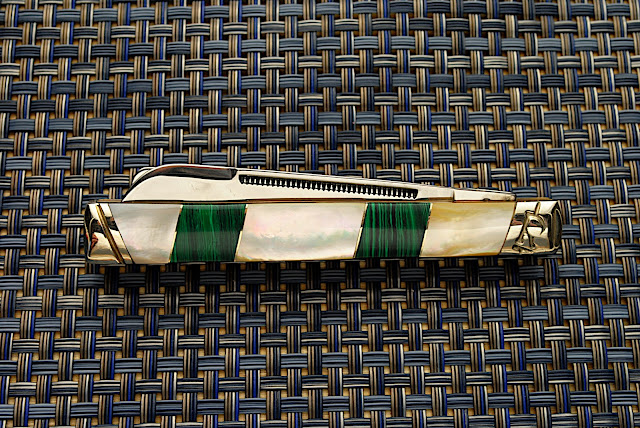

Rough Ryder's Doctor Knife

“…this was entirely done by hand. The pill mass was rolled into the form of a cylinder, placed on a graduated tile and divided by means of a spatula into measured lengths calculated to contain the required amount of active ingredients. These were then rounded between finger and thumb to give the final product.”  Hong Kong Medical Journal 2015.

Of course, the blade was needed to lance boils and carbuncles.  Medicine in the early 1900s was not for the faint of heart.

I’ve always been fascinated with spatulas.  As a chemist, I used a variety of sizes to weigh out chemicals and unknowns.  Then I turn around and see a chocolate maker use the same tool.  Take a step and you’ll find printers keeping the ink in the printing bank mixed and evenly spread out with spatulas.  You’ll find them in kitchens, paint and pigment stores, in labs and pharmacies, but you’ll seldom find them with doctors.

I don’t see too many doctor knives around, especially the older ones, so I was happy to find one from Rough Ryder.  Yes, they changed their name from Rider to Ryder.  I don’t know if it was the condom association or Teddy Roosevelt.  Perhaps the change was just a public relations move to get more notice.
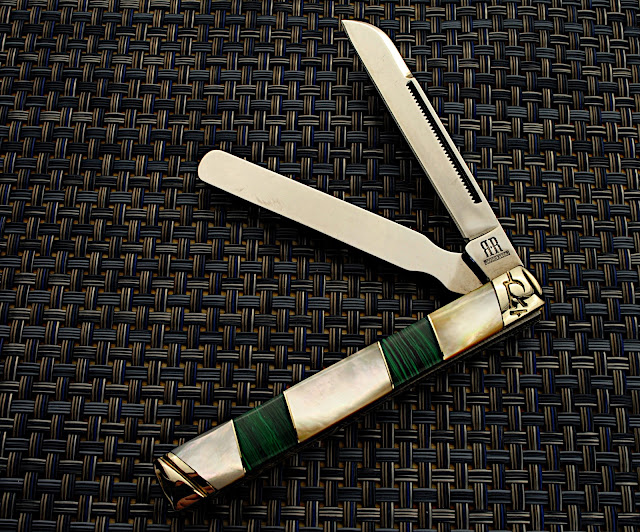

I think of that blade as more of a sheep foot blade, but there is a high degree of freedom in naming blades 

The knife is 3.6 inches closed and has nickel silver bolsters.  It has a spey blade and the traditional spatula.  The handle is malachite and pearl from Stoneworx.  The knife has brass liners and the two blades are separated by brass as well.

All and all, it is a really nice doctor’s knife and I really like it.  Rough Ryder has an upscale group of knives, and this is one of them.  It is a nice example of knife art at a reasonable price.  You can buy one for the princely sum of $26.00.

I hope you enjoy it as much as I do!

Friday, November 5, 2021

Sea Snake

I finally got around to breaking out and using Artisan Cutlery’s Sea Snake.


Artisan Cutlery, sea snake, G-10 handle
Artisan Cutlery's Sea Snake


I came across it at the 2021 Blade Show and it followed me home.  I’m sorry I waited so long to break it out. 


Artisan Cutlery is a Chinese company making innovated blades as well as using interesting steels.   My Sea Snake was crafted from AR-RPM9, a proprietary powdered metal steel.


The formulation?  Well, it’s proprietary, but few compositional secrets remain secret for long.  Here’s what I found on the Internet:

0.9% Carbon,

18% Chromium,

1.0% Molybdenum,

0.45% Manganese,

0.1% Vanadium,

0.30% Cobalt,

0.2-0.8% Silicon,

less than 0.40% Nickle,

less than 0.05% Rare Earth.

I’ve never seen anyone list or express concern about rare earth composition.


Chemical analysis can tell you what’s in a product, but not necessarily how it performs.  Looking at these numbers, I could do this analysis with a half decent SEM and EDS.  There are no significant elements below 0.1%.  But like Coca-Cola, it’s how it’s cooked that makes the difference.  That would take some real research into metallography to unwrap those secrets. 

In any case, enjoy this steel, because I am.


The 3.15 inch flat ground Wharncliffe blade is fixed to a G-10 clad handle giving the knife a total length of 6.78 inches long.  The blade has a RHc value of 59-61.


I like the feel of the knife in my hand and I can’t stop playing with it.  The balance point is back in the handle and the finger groove provides plenty of grip and prevents you from sliding onto the blade.  That’s always important to me.   There is a secondary finger groove carved into the blade shortening the actual cutting edge to just under 2.5 inches.  Using the two finger grooves and the jimping on the blade’s spine locks the knife in my hand and gives me fine control over the blade.


The knife is designed by Mike Embler.  Mike is from eastern Ohio and spent 18 years in the  Navy.  He studied multiple forms of self-defense, including Japanese swordsmanship while stationed in Japan.  This helped shape his views on knives as tools and weapons.  It was in Japan he discovered the joys of flat grinds.

You should keep an eye out for him, I think you’ll be seeing more of his work.


Dressed-up accessory, neck knife, Wharncliffe blade
Dressed up  and ready for a night out.


I got the green G-10 handled knife in the khaki green sheath.  It seemed like the right color for a Sea Snake.  But the black para cord it came with was the pits.  Not content with that, I dug out some woodland camo paracord and found an almost matching green and orange glass bead and dressed up the sheath. 


Neck knives are becoming a fashion accessory for men; women too! 

Yes, I know they started out as a hidden weapon, worn under a shirt or blouse, a tool of last resort, likely to be missed in a fast pat-down.  But really, those days are gone.  Everyone checks around the collar for the tell-tale cord, pats the chest and under the arms.  Then there’s the metal detecting wand.  Just wear it as a fashion accessory.

Besides do you really want to go into combat with an unbreakable noose around your neck?


You can get you’re Sea Snake at https://www.artisancutlery.net/sea-snake-atz-1842b-g10-ar-rpm9?search=sea%20sNAKE&description=true for $39.98.  They currently have a limited issue made with S35vn steel and another with a carbon fiber handle at prices reflecting the more exotic materials.