Monday, July 12, 2021

Young Turk

I ran in to a young man who is just starting to make knives.  For the last two years he’s hammered, removed stock, taken classes, sharpened edges and dropped a lot of sweat on the ground.  Why?  Because David Pienta wants to be a master knife maker.  But the road is long and twisty and not everyone makes it, but he’s starting.  Right now he’s working with stainless Damascus steel he hammer forges himself.  
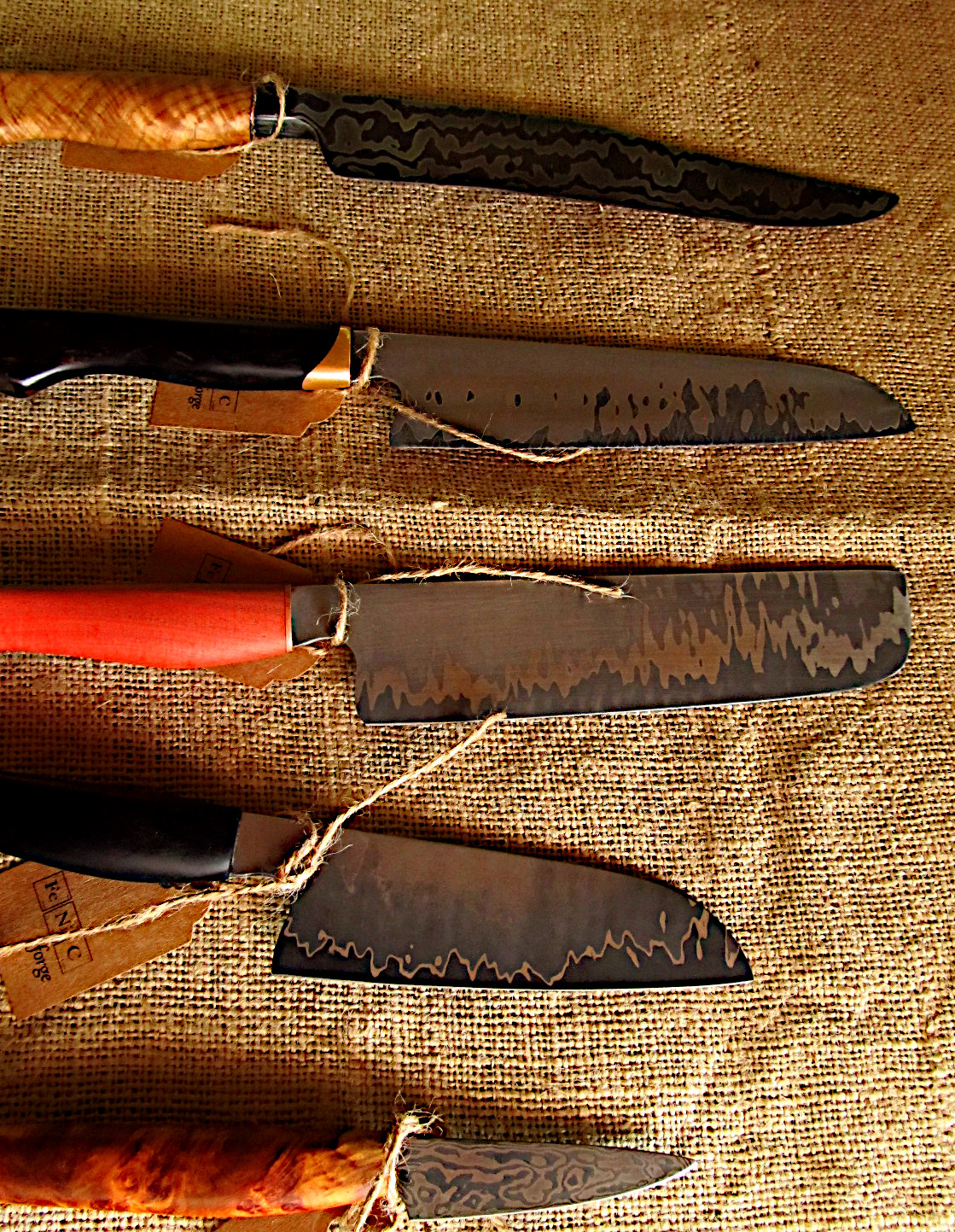
I bought the one on the bottom

The name of his forge?  Fenic Forge.  The name derives from the chemical symbols for iron, nickel and carbon, important elements in steel.  He doesn’t have a tang stamp yet and I urged him to.  Many of his knives are objet d'art and without a tang stamp their value will be less.  I’ve handled too many nice knives that everyone simply shrugged and said “Beats me who made it or what it is worth?”
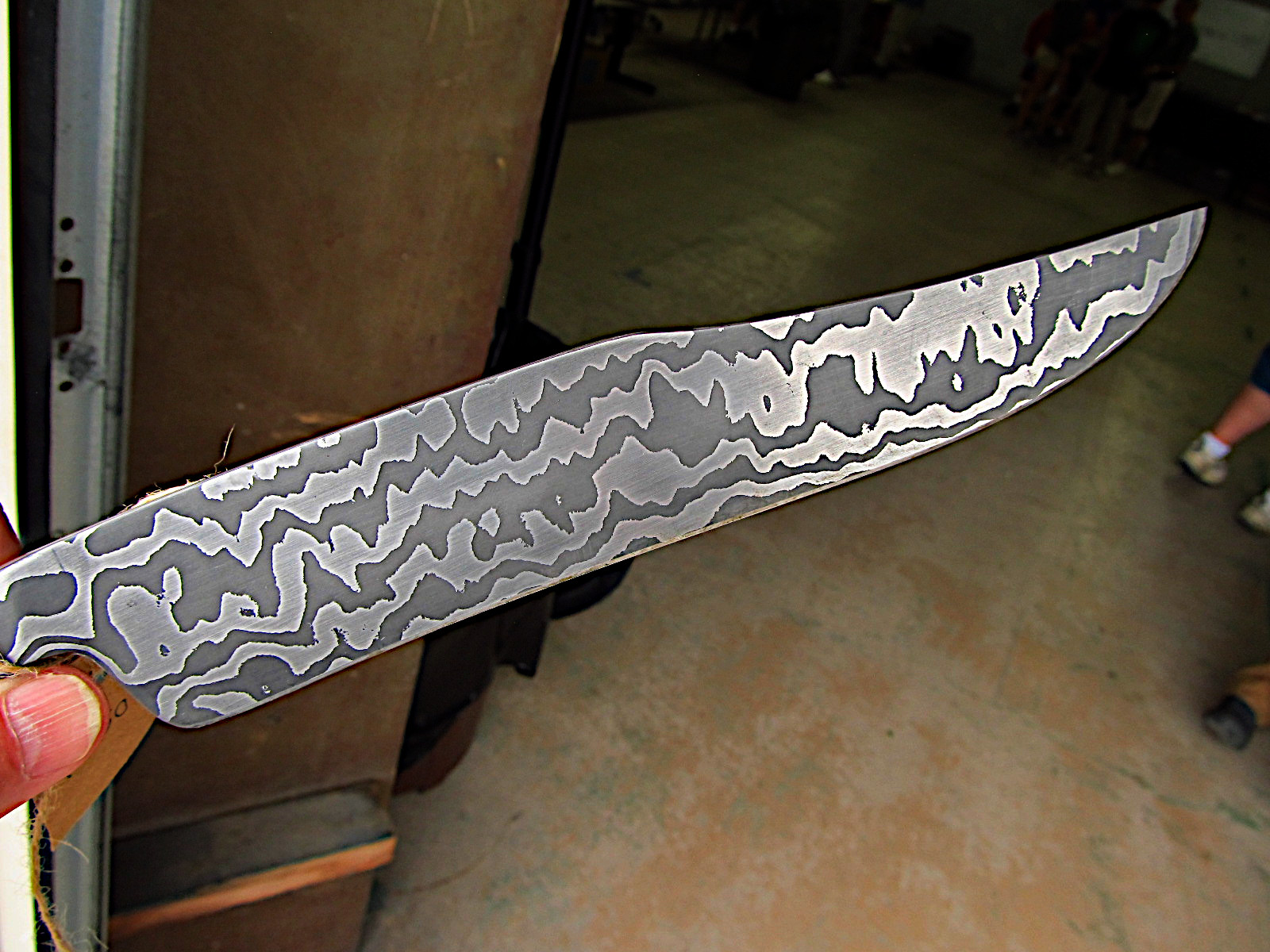
Bold Tiger Stripe Damascus

We disagreed on the artistic nature of his stainless Damascus choppers.  He thinks they are practical Choppers.  Perhaps.  I think you will not see too many Damascus knives as choppers.  Yes, I know the maker has the edge on what he thinks his knives are for, but it is really up to the consumer.

I bought a small kitchen utility knife, maybe seven layers of steel in an exotic burl handle. The handle has good symmetry and the blade has nice lines for a small working knife.  The small number of layers allows the differences in steel to be bold statements.  The working edge ends with a gap between the steel blade and the handle.  I like the way my finger sits in that place, so clearly defined with no worries of sliding onto the blade.


My kitchen utility knife

I’m going to sharpen it bit more and treat the handle to a good wax coating and Karen will have a special kitchen knife.

You can find David on Instagram or http://fenicforge.com/.

Sunday, June 20, 2021

Spyderco K390 steel

It an Endura, one of Spyderco’s top selling knives. But this one is a little different . It has the new K390 steel blade. The flat grind blade is quickly becoming one of my favorite configurations. I grew up with saber and convex grinds but I’m won over by the flat grind. The absence of shoulders makes for easier cutting. If you’re slicing a wedge of Swiss cheese, you may want the shoulders as they push the materials apart and away from the knife. But you also encounter drag. Drag just means you have to put more force on the blade, and for most applications, forcing a blade is never a good idea. So I’m running some test because K390 steel sounds like a step backwards.

It’s not stainless. In fact a product insert warns you to protect the blade.

Bohler-Uddeholm list the following reasons to use their K390 Microclean steel:

  1. Good machinability because of uniform mechanical properties,
  2. Excellent grind ability even with deep engraving in the tool & die center,
  3. Uniform low dimensional change during heat treatment,
  4. Non sensitive against overheating or long soak times.
  5. Optimal EDM characteristic due to uniform carbide distribution.
EDM is Electrical Discharge Machining and it is becoming industries’ favorite machining and milling tool because it is efficient, economic, fast, controllable and computer-driven. Many of these steel properties, like dimensional stability are a big draw for knife makers.

The Chemistry also looks interesting.

  •  C  2.4%,
  •  Cr 4.2%,
  • Mo 3.8%,
  • V   9%, 
  • W  1%, 
  • Co  2%.

I should also note, new steels aren’t simply made by dumping elements together. Tempering, stress relief and hardening cycles have a major part in any production metal. Still, I find these numbers amazing, especially the 9% vanadium and 2.4% carbon!

Strictly speaking chromium levels should be around 11% to be classified as stainless. Chromium forms carbides that stabilize the microstructure, so in ordinary steels you need an excess of chromium to react with carbon and still have enough to protect against rust. Here you have vanadium to form carbides. So is there enough chromium to form the transparent chromium oxide barrier?  I don’t know.

Let’s play.

I’ve been cutting cardboard all week, I haven’t noticed any loss of sharpness. Today I cubed semi-frozen beef for a future chili dinner. I thought the knife handled better than many of the larger chefs’ knives or the smaller utility knives.
I sliced up some lemons and limes for summer drinks and the knife worked fine.

Tasted pretty darn good, too!


Afterwards I noticed the acid fruit left a start of a faint patina. I could lightly rub it out with a fine metal polish, but I think I’ll keep it. I like a working knife that looks like a working knife.
I increased the contrast slightly so you could see the patina. I'm wondering if it will wear away on it's own.

I think the K390 steel is going to be a winner. I haven’t had to sharpen it yet, but I have no doubt my Spyderco Sharpmaker is up to the job. I understand you’re going to see K390 steel in a lot of other Spyderco products. I also think you’re going to like it.