Monday, December 3, 2018

Christmas Reading


I can’t imagine Christmas without a new book.  They are one of my favorite gifts and some have become lifelong friends requiring several readings over the years.


Here’s a list of books that you might find want to find in your Christmas stocking.


Terzuola

  The Tactical Folding Knife   Bob Terzuola
A detailed approach to knife making from one of the masters, Bob Terzuola.

A Primer on Folding Knives  Steven Roman
Overview of knives, steel heat treatments and sharpening.  With the exception of types of steels used for blades, there is probably nothing more contentious than sharpening.

Pocket Knives –A Compete Study Guide  Bernard Levine
It’s a nice introduction to knife collecting illustrated by color photo examples.  Almost every level of knife fancier will enjoy this.

The Complete Encyclopedia of Knives  A E Hartink
Of course, it’s not complete.  It is a snapshot of knives and some makers at the time of publication.  But it is a coffee table book you’ll enjoy picking up again and again.

The Craft of the Japanese Sword  Leon and Hiroko Kapp
Fascinated by Japanese swords?  Like many of us we have an imperfect view of the creation, finishing and style of these swords.  This book will give you insights and appreciation for the classic Japanese sword.  And why it takes a village to make a sword.

Art of the Knife   Joe Kerzmzn
Art knives are curious.  Makers take one of man’s earliest tools, the edge, and turn them into objects of art.  You can own a copy of Piet Mondrian’s painting called Composition No. 10, but by its nature you can’t own a copy of an art knife. It is or it isn't.  But you can explore them.

100 Legendary Knives  Gerard Pacella
Make a list of the top 10 knives; now expand it to 100 universally accepted standards.  It’s hard to imagine the complexity of such a task.  You may disagree with this list, but you will not be disappointed with it.

Modern Knives in Combat  Deitmar Pohl
You might be surprised by the knives men and women carry into combat.  You’ll find designer edges and ones you see at any gun show in America.  Gives you a different view of the tactical knife.

Contemporary Knife Targeting  Christopher Grosz and Mike Janich
Is there anyone who has never picked up a knife and not asked themselves, “Could I defend myself with this?”  We’ll always go places you can take a knife but not a gun.  Just saying……

Counterfeiting Antique Cutlery  Gerald Witcher
It’s not a how-to book, but more of a they-did-it–to-you book.  If you’re thinking of collecting in the high end or rare collectable market, you really should read this book.

Merry Christmas to you and keep your edge and your knife sharp!

Wednesday, November 21, 2018

Figuring The Angles!


If you use a knife there comes a time, regardless of the steel, that the edge needs touching up.  Many of us return our knives the company for resharpening or take them to a professional sharpener.

Even thinking of this brings to mind a childhood memory of an itinerant knife sharpener on the south side of Chicago.

He had a push cart that he walked behind and sang out “knife … scissor sharpening” as he traveled down the street.  It had little bells that tinkled and jingled as the cart rolled.  He would sit at the stone which was powered by a foot treadle and sharpen.  I remember my mother with a pair of scissors that needed sharpening as well as all the women in the neighborhood coming out to see this old man and his grind stone.


Not the same one, but similar


I always wondered where he came from and how he got into the business. 

Companies make all kind of sharpening aids.  I had a guide that clipped on the blade of a Buck knife and held it at constant angle.  I didn’t say correct, just constant.  Both sides are worn down from years of use.  I have a Lansky that also clips on the blade and lets you select one of several predetermined angles.  The Spyderco Sharpmaker currently has two predetermined angles, one for back beveling the blade (30 degrees) as you sharpen into thicker and thicker steel and their standard (40 degrees) for sharpening.  Of course you can use either angle for your sharpening your knife.

Some of us can hold a constant angle on a flat stone and simply select an angle based on their experience.  I’m not one of those, but I can free-hand a dull edge into something significantly less dull.

The Work Sharp sharpener comes with several different grit belts but the really attractive part is the dial-an-angle feature.  Simply turn a knob to a predetermined value and you have your angle.  It’s up to you to hold the knife against the supports to get that angle, but it’s not that hard.

powered sharpening
The numbers are the angle and you can swap different grit belts.  The system produces what people call an appleseed or hamaguri grind
Sharpening connoisseurs claim you should find a specific angle for the steel and hardness of your blade and your applications.  I remember a fellow collector, who had the resources of a world class lab at his bidding who addressed this question.  He purchased throwing knives from a single vendor to get the same steel and hardness, and sharpened them with many different angles and types of abrasive grits to determine the “best” angle and method.  Then he had to establish a reproducible cutting test that measured the friction through leather.  Scanning electron photomicrographs were taken of edges before and after testing.

 
I suspect he determined the best way to sharpen that particular knife and not the one in your or my pocket.

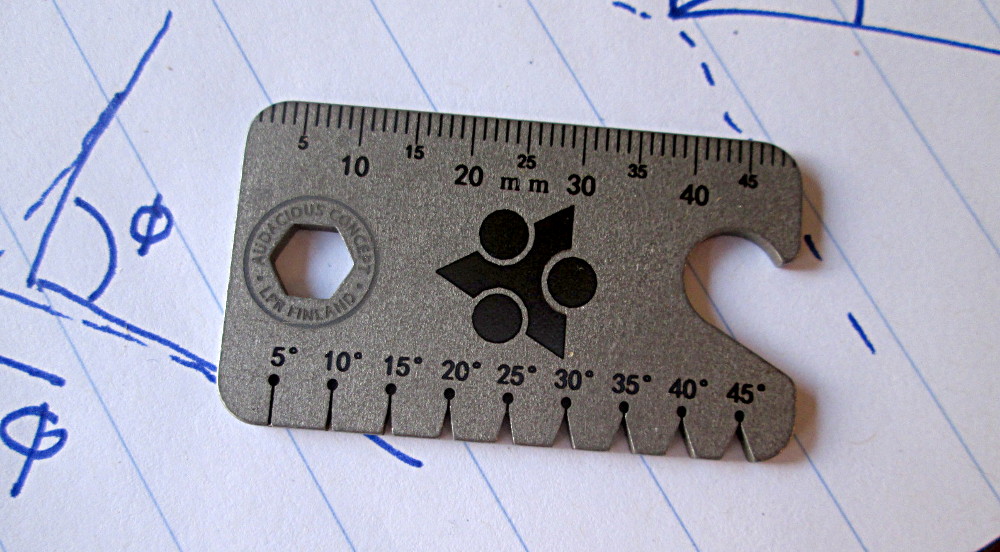
Still it’s the angle you need to know.  Audacious Concept, located in Lappeenranta, Finland has the solution for you.  It’s a little dog tag that has precision cut angles from 5 to 45 degrees by fives.  Simply slip your edge into each slit until you find the best fit.  Best fit seems to be when the edge wiggles the least in an angle.

And you get a beer bottle opener!
You can estimate values in between if two adjacent angles both seem to have the same wiggle.

This lets you set your sharpening system to the factory angle or what you have discovered for your knife and use. 

Sure, you could just select any angle, or you could engrave the factory angle somewhere on each blade.  You could keep a notebook with the name and description of each knife with the factory angle and your sharpening angle.  You could do a lot of things.

Or you could just buy one of these little dog tags and keep it with your sharpening supplies.