Wednesday, May 17, 2023

Finnish Delight

 Iisakki Järvenpää Puukko

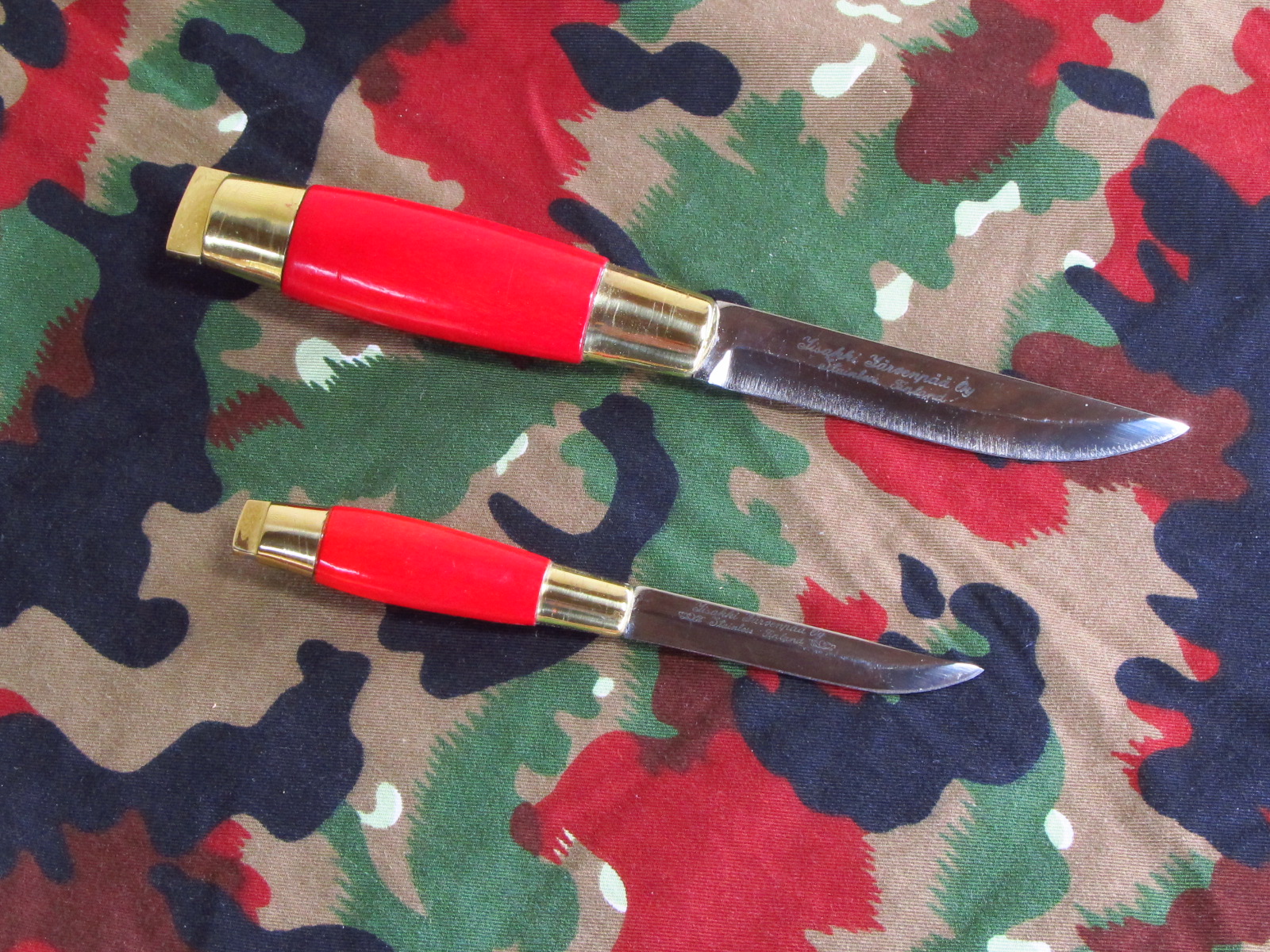
I recently picked up a lovely dual Finnish puukko set made by Iisakki Järvenpää Osakeyhtiö.  The puukko set is a traditional dress knife pair with a painted red handle and brass fittings.  The two blades are engraved with the founder's signature, Iisakki Järvenpää.

I have recently discovered an interest in puukkos.  I admire the refinement and practicality of a knife designed to survive in the brutal arctic environment.


Puukko knives
A Puukko by Iisakki Järvenpää Osakeyhtiö

A puukko is a general-purpose belt knife with a single curved cutting edge, solid hidden tang, and usually a flat spine.  Military models of puukkos have been popular in the Russian criminal underworld under the name "Finnish knife" or finka since the 20th century. 

Puukkos don’t have a ricasso (a section of the unsharpened blade nearest the handle) because this is where the most power can be applied.  While finger guards are uncommon (it is a cutting tool, not a stabbing weapon), puukkos intended to be used in wet or slippery environments will have some form of guard or grip enhancement carved into the handle.

The short knife is 5.75 inches long, while the larger one is about 8.5 inches.  They occupy a leather and brass sheath.  The front is partially painted/coated in red to match the knife's grip.

This set appears to be part of traditional ethnic dress, needing only a Helavyö belt.  The Helavyö is a leather belt decorated with several metal plates (or "hela"s).  The belt is an accessory worn by men and women in traditional garb but only by men in non-Karelian attire.


Karelian Dress
Traditional dress with Helavyö belt and knife set


The Karelian people are from an area in Northern Europe with historical significance for Russia, Finland, and Sweden.  Often, a trinket of some shape hangs from each metal plate.  The pendants are a pretty decoration; they show off the wearer's wealth.  As a bonus, they are reported to keep the devil away.


Hot girl with metal belt
Non-Traditional dress

The company’s founder was Iisakki Järvenpää.  He was born on January 7, 1859.  From an early age, Iisakki was curious and thirsty to learn everything new.  He practiced his reading and writing skills on his own initiative.  While writing, he practiced not only the writing skill itself but also his penmanship.  His attraction to uncompromising and meticulous visuals is reflected in his knives and writing.  Iisak's signature is the company logo.

Red handled Puukkos

The Iisakki Järvenpää Company was founded in 1879 and is the largest manufacturer of knives in Kauhava, Finland, a well-known town with a long and rich history of knife making.  He had to learn everything from forging to metal polishing.

Self-taught, Järvenpää made simple work knives, but in 1888 he made a gift knife for the hereditary prince of Russia and the future emperor Nicholas II.

Because of the gift knives' impact, Iisakki received the title Keisari's knifesmith, which was entered in the church's books in 1889.  Keisari's blades had the lion coat of Finland carved into the handle and the emperor's crown on top of a lion.  The imperial thanks from future emperor Nicholas II received a lot of attention in newspapers nationwide, which led to a widespread increase in the demand for Iisakki’s knives.

Despite this success, his knife business grew slowly.  Wanting more for his family, Iisakki gave up 20 years as an independent craftsman and became a foreman at the newly founded knife factory in Kauhava.  Discovering the company had lied to him about benefits, he resigned from his position and re-established his own knife shop on February 15, 1904.  From this point, Iisakki's company became known as Iisakki Järvenpää Osakeyhtiö (Limited Company).


The larger Puukko with signature in the blade
Iisakki died on March 6, 1929, but his company continues, and the knives are made by hand in Kauhava, Finland, from locally sourced materials.  You can find out more at: https://www.iisakkijarvenpaa.fi/us/story


Any errors are from my misunderstanding of the translated Finnish.


Thursday, April 20, 2023

Pro-Tech Steam Punk

Every once and awhile, you come across hidden treasures.  Sometimes neither the buyer nor seller realizes how much that gem is worth. 

When you’re the seller you may never find out.  Smart buyers will not tell the seller he has made a foolish move.  They will not rub it in or humiliate the seller.  It’s enough to get a silent win. 

Then too, you don't know what they paid for the treasure; they could be laughing all the way to the bank.


I didn't gamble on this!


I recently bought a Pro-Tech Godson with Bruce Shaw’s Steam Punk motif in bright metal.

I really like the Godson.  For me, the size is Goldilocks, that is, just right.  The knife is easy to Google, try: https://www.bladehq.com/item--Protech-Godson-Steampunk-Automatic--67879

But all the websites I visited say they are out of stock.   They also say the knife they had was some number of 200.  Mine says 72 of 100.  What’s going on?

I called Pro-Tech and asked.  Here’s what they told me.  Pro-Tech makes a special run of 100 knives called prototypes, sold only at shows.  The regular limited edition has 200 members, making a total of 300 Steam Punk Godsons in existence.


My new Steam Punk claims to be a prototype 72 of 100 while my older copper one is from a run of 200 .  What is going on? 

Pro-Tech has no plans to make any more.  I don't know why.  Perhaps it was a limited edition, as the artist Bruce Shaw specified.  Bruce got his training at Cal-State University of Los Angeles.  Bruce is better known for his firearm engraving, but his Steam Punks are icey! 


When they were introduced in 2014, Blade Magazine listed them as "Investor/Collector Knife of the Year."  I don't know about the investor part of that claim, but it is very collectible.

I’ve always been cynical about knives as investments.  It’s counterintuitive, but many custom knife makers experience a drop in value when they die.  They are, after all, done.  There will be no new creative work to keep their name in the public eye.  As their collectors pass on and leave their collection to people who don't care, the custom maker becomes increasingly a closed chapter.

It doesn't always happen that way.   Randall Knife is one example of a knifemaker going strong after their death.  Bob Loveless is another.  The corporation with his name marches on.

Despite those two examples, I am reminded of the joke:  How do you make a small fortune by investing in knives?  Start with a large one. 

I'll share what I learned about stamp and coin collecting.  If you want your collection to have great value, put great value into it.

I also have the copper version of the Godson Steam Punk with a bright blade.  It is part of the regular limited run of 200, but I'm thrilled to have it.  I also assume there is a prototype run of 100 somewhere.

There might be more prototypes and limited run consisting of only bright of black blades.  I don't know.


I doubt I'll buy another Godson Steam Punk for my collection.  I'm not interested in having some unique number sequence or group of numbers.  But if the price is right, you could see it on my table.

Thursday, March 2, 2023

Club Knives

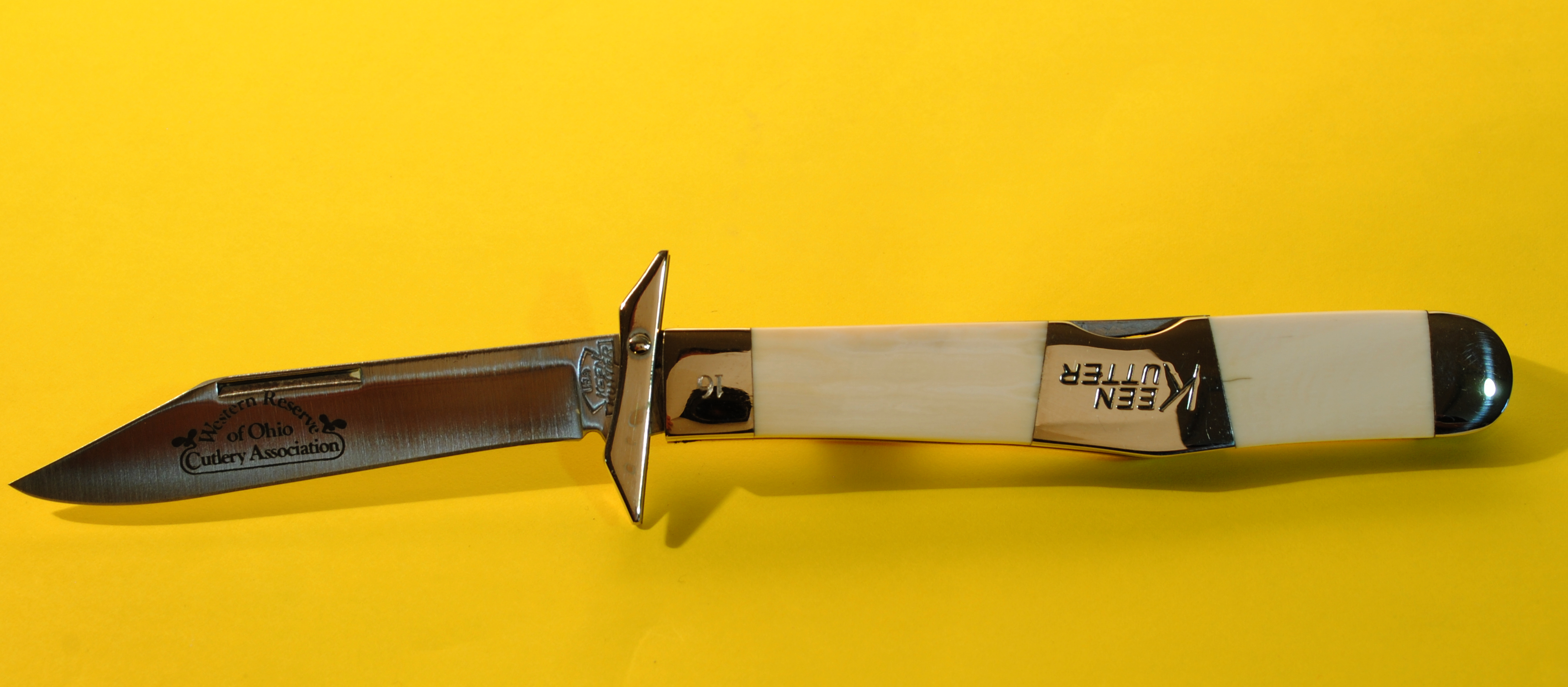
 I’m not a huge fan of club knives.  Most club knives have a simple engraved blade and little else to recommend them.  However, I do occasionally purchase them.  My local club, Western Reserve Cutlery Association, had a swing guard with an ivory handle from Keen Kutter that I bought.  By comparison, most current club knives seem ordinary.

WRCA Club Knife...They forgot to have the year engraved.


Recently I found a Gerber NKCA knife from 1986.  It was number 3013 of 6200.  The raised NKCA shield over the blade pivot caught my eye, as did the excellent brown jigging and engraved blade.

NKCA stands for National Knife Collectors Association.

1986 NKCA Club Knife  one of 6200.  That number amazes me!

You don’t hear much about the NKCA anymore.  I googled their name and found a website selling cheap chewtoy holsters.  You take the metal parts off, if any, and give the holster to your dog to chew on.

NKCA started in 1972 when a group of collectors/dealers working at knife shows in Kentucky and Tennessee realized there was a growing market of knife enthusiasts and collectors.  They decided to form an association to grow a hobby into a profitable (keyword profitable) business.

It shouldn’t surprise you to discover the original name was the National Knife Collectors & Dealers Association.  After a couple of years, the dealer part was dropped.  Too much honesty, I guess.

James F. Parker was the first elected president in 1972.  He was a leading knife dealer at the time.  Parker was an interesting fellow.  James F. Parker founded Parker Knife Company as a sideline to his employment as a paint sales rep.  He was one of the first to effectively utilize direct mail services to buy and sell collectible knives in the 1970s.  Parker helped start Frost Cutlery by partnering with James Frost in a short-lived partnership and owned Case knife for a short time.

Parker guided the development of the NKC&DA to include enrolling members nationwide with a yearly membership fee.  They received a small monthly newsletter which developed into a monthly magazine.

1974 was two years into his presidency and Parker thought outside the box.  He proposed a "Collector's Knife" to be made exclusively for members.  Essentially, Parker originated the almost universal club knife, primarily to promote membership and a degree of eliteness.  Only members could buy a limited-edition knife from the NKC&DA.  This was unheard of at the time!  That factor drove the desire to be able to own one of these knives to high demand!


Parker chose an Anglo-Saxon whittler pocket knife with the most desired Case XX pattern 6391.  But Parker had difficulty finding a U.S. manufacturers willing to make the 1200 knives. 

Howard Rabin of Star Sales in Knoxville, TN, stepped up.  Rabin was the U.S. importer of German-made Kissing Crane knives.  His company wanted to be part of this new venture and eagerly made the 1200 knives Parker asked for.

For fun, I've converted the prices to 2023 dollars in parentheses.  The days of buying a new quality pocket knife for under $20 are gone.

NKC&AD sold their first club knives for $12 ($73) and only one knife per member.  They didn’t sell out as anticipated.  Being savvy or perhaps desperate businessmen, they created a second offer to their members.  Each member could now order up to three knives each at $15 ($83). 

Thus began club knives being used for promotion and as fundraisers.


Sold in 1986 for the equivalent of $106


In 1975, the desire for these limited edition NKC&AD club knives pushed the knife price to a staggering resale price of $600 ($3336).  The 1976 club knife, a Case XX 4380 whittler with a production of 5,000, would sell out!  The price of $15 ($83) would peak at a resale value of $250 ($1390).  The 1977 club knife was a Kissing Crane stag handled gunboat canoe knife and 6,000 were produced, followed in 1978 by 8,000 IXL Wostenholm green bone handled three blade canoes.  The peak number of knives produced for NKCA was in 1981 with an issue of 12,000 made by Queen.

That was high point of NKCA club knives.  NKCA membership started to decline as did the number of annual club knives produced. 

Regional clubs wanted their own club knives, and the uniqueness and potential for up-market sales decreased.  Soon, various regional clubs had copied all the rare vintage and unusual patterns.  Clubs would try many variations by changing the handle materials, shifting blades around, adding blades to existing patterns, etc.  Nothing worked as well as the early revival of long discontinued vintage patterns originated by Parker and the NKCA.

There were so many club knives that it made it almost impossible to collect them all.  The oversupply had affected the value of the knives. 

Soon the resale value of a club knife was the same as the knife without the club markings.

In the end, the NKCA folded.  The exact date seems hard to determine.

There are still more than enough hard feelings to go around.  In 2010 an NKCA life member posted on Blade Forum:

“The NKCA became a slick scam by a series of office managers and presidents and sgt. at arms and various other 'officials' who helped to bankrupt what was a 3,500-member organization with a brick-and-mortar, state-of-the-art museum that I am grateful to have visited once.  Jim Parker, bless his soul, bought the land for 50 thousand and built the museum.  The thieves and scoundrels; yes, you heard right, going back to the thief who never delivered the pearl-handled 'club' knife forced the closure of the museum and the sale of the museum property for 1 million, all of which went to pay the NKCA's debts.  They should all have been 'hung'; both men and women!"

So, club knives?  Are they a scam?  A gimmick to make money and attract members?

Maybe, but I suggest you buy based on what you like and not a financial investment.  The 1986 NKCA knife was sold for $39.00 or $106 in 2023 dollars.  I found my knife for around $50, but I see others trying to sell at $125 and they collect dust. 

Will the WRCA club knife increase in value or just get lost of the ubiquitousness of club knives?


Tuesday, January 24, 2023

TOPS Lite Trekker

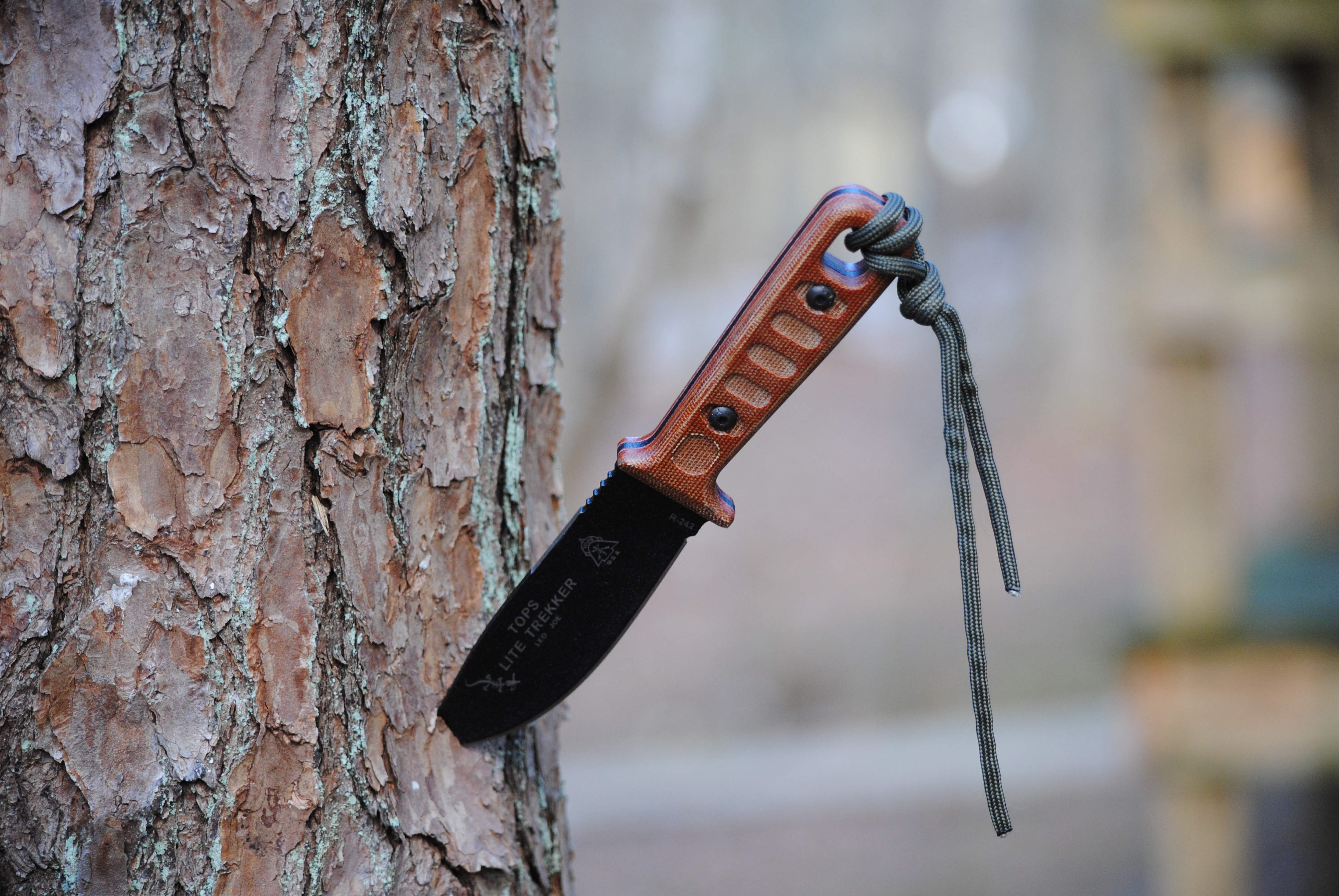
 One of my favorite fixed blades is the TOPS Lite Trekker.  It is a little lightweight knife that performs in a heavier weight class.  I picked mine up at the 2015 Blade Show.  Seems a company was offering free laser engraving with your purchase.  Somehow, the wrong name was lasered into the steel and I found it marked down on the last day of the show.


Why would I want a knife with someone else’s name on it, especially a misspelled name with lots of tricky letters and vowels?

Simple, I had the retailer laser out the name, leaving me with just the show date.  Later, I wrote an article about it for Knife Magazine.  Yes, Mr. Pasknyuskas III’s knife worked out well for me.

The knife locks into a deep kydex sheath with a positive click.  It’s not about to bounce out and be lost in the weeds because you took a fall.  The overall length is 8.75 inches long.  The blade measures out  to 4.25 inches long.  The Lite Trekker weighs in at 5.1 ounces.

TOPS describes the blade as a Hunters Point.  I see it as a basic drop point.  The steel is 1095 carbon, so a little oil and blade dressing is needed to keep the edge in great shape.  The steel is hardened to a RC 56-58.

I hear you.  I know a bunch of you whiny little mall commandos are telling me you only carry the newest super steel hardened to at least RC 60.  I’m not going to attempt to convert you, but remember, hardness and brittleness are related and a bent knife is still a knife but a broken blade is just junk!

I’m going to swap out the olive green paracord for something a little brighter to make it easier to find when I place it on the ground.

The Lite Trekker comes with a variety of color inserts built into the handle.  I like mine a lot and you can find it at https://www.topsknives.com/tops-lite-trekker  with a MSRP of $195.