Monday, January 16, 2023

Fingers

      The problem with sales, of course, is the customers.

They ask such questions, act so aggravating and in general, can be a real pain in the tuchus.  But to a large degree, they are untouchables.  You clench your jaws together, bite your lips, force a smile and generally restrain from violence.


I have nothing but respect for people employed in the service industry because they have to deal with jerks like me.


One fellow after inspecting several knives kept coming back to the same folder.  “I’ll take this,” and he pulls out a wallet and hands me a dollar.  I want to say “There isn’t a knife at this show you can buy for a dollar.  Not even at the 3 for $5 knife buckets, not even at the TSA guy who is selling junk knives confiscated by TSA and sold to vendors in 100-pound lots.”

“I need a 99 more dollars, sir.”  He doesn’t have to know SIR stands for Simpering Imbecile Retard.

Realizing he had misread the price, he said, “Oh, I thought it was a dollar.”  I want to ask him how much he paid for gas last week or if he has bought a dozen eggs in the last 6 months.  How could he think a knife could sell for a dollar?  But I don’t.

He looks embarrassed and I sputter for a second before I come back with, “I’m afraid not, sir (See!  There’s that word again.)


Later another guy walks up and asks, “Do you buy knives?” 

The answer is the first rule of improv comedy, “Yes, I do.”  I modify that with “Sometimes.  What do you have?”

That’s the setup and here comes the spike, “I really would like to trade knives.  I have a switchblade and I’m looking for something else.”  Oh!

The switchblade is a POS with a secondary seatbelt cutter built into the handle.  The poorly made knife is of Chinese origin.  Having it on my table would make a mockery of the expensive, well made Chinese knives I carry. You might get 25 bucks, including tax and shipping for it, retail.  The least expensive auto I have is $53.

“I don’t think it’s right for me.”

“I have two of them.”

I want to tell him, that’s not a positive negotiating point.  I want to tell him even if we tossed in the price of the knife he wanted, I’d be stuck with a POS I can’t sell.  “Thanks, but no thanks!”

Understand, you have to be nice.  They may come back later with a more collectable knife in the future, perhaps we can do business later.


Later I’m presented with an old, worn, dirty, over-sharpened Case knife, and told it had to be over a hundred years old, because it belonged to his 90-year-old grandfather.

I don’t ask if the birth was difficult as the baby was born with a 10-year-old knife in its hand.  It also raises some interesting ideas about Mom’s everyday carry.

He pauses and seems to be waiting for me to make an offer.  “It must have great sentimental value to you.”  Which is code for put that back in your pocket and unless you are shopping, get away from my table!

I don’t bother telling him and others that old is not the same as valuable.


I enjoy talking to knife collectors and fanciers but don’t bother me with your tales of why you don’t need one because you have a two-bladed knife you bought in the 60s and have proceeded over the last half century to sharpen the life out of the blade.  You think you’re clever, making do with it until you sharpen the last atom of iron off the blade. 

I want to let you know you’re making a wise choice in keeping that knife because the current knives are too much and far beyond your abilities.  I don’t.


Midway through the show, I get an offer of 70 bucks for a $120 knife.  I politely decline and countered with $110.  He walks away.  I’m very cool with that.  Knife shows aren’t quite a store and a little bargaining can be expected.  But I’m not a flea market either.

He returns a couple of hours later and reexamines the knives. 

“You said 70 on this,” he says.

I laugh and say “No sir.”  Here is where I screw up.  I continue with “I said $110.” 

He said, “Well, I thought you might have forgotten.”

I should have said “I said $135.”  And if he objected, pointing to the marked price and his memory of our discussion, add “There’s an increase for failing to bargain in good faith.”  But I didn’t.


But sometimes the interactions make it all worthwhile.  An older woman comes up and is interested in the SpyderCard on my table.  I tell her they are hard to find and she agrees and pulls one out of her pocket! 

Then she shows me her favorite knife, a very nice CRKT long since discontinued.  She carries it wrapped in a clean handkerchief to protect it. 

I show her the protective sleeve I buy to protect some of my knives in transit, but I can’t sell her one because I don’t have any pricing or even the name of the product, just the sleeve.  We successfully negotiate the price on the Spydercard.  I make a little less money, but turn product into cash.  She spends a little less and gets a knife she really wants.  I like talking with her so much, I throw in a siliconized knife sleeve to protect her favorite knife. 

I had a very good time.
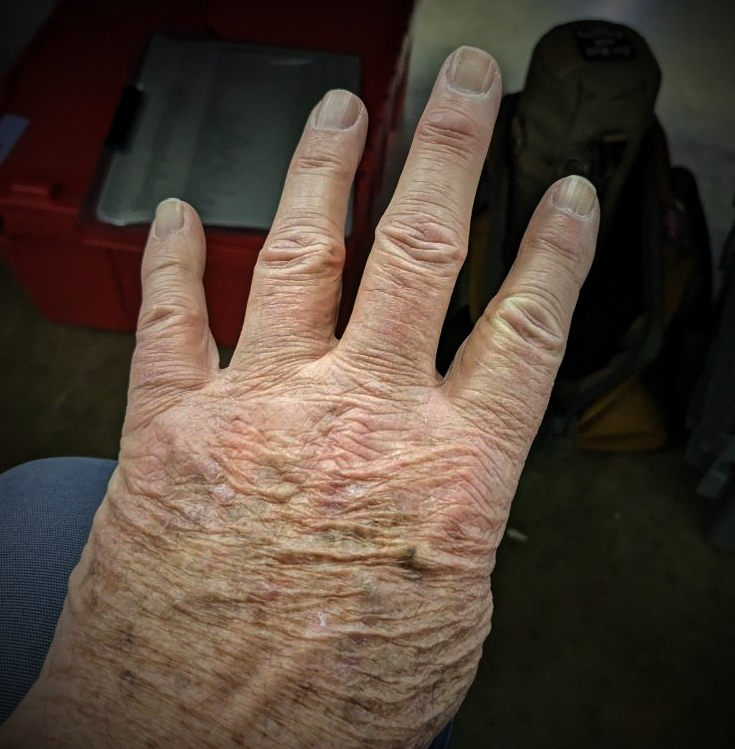


Where is my missing finger?


During the entire show, my wife keeps asking me if I’m alright.          I’m always a little nervous about shows.  We bought all those knives.  Did I buy the right ones?  Did I make good trades?  Am I reading the market right?

Finally, after being asked over and over if I’m alright, I look down at my hand and start to jump up.

“Oh!  My GOD!  I only have four fingers!”  I point to the hand with only four fingers.

Now she’s agitated.

“Only four.”  My voice gets a little louder and more excited.  “I’m missing a finger.   What happened to it!”  She is beginning to get alarmed, not thinking everything through, after all we handle a lot of sharp edges.

I turn my hand over to show my thumb tucked under my palm.

“Oh!  There it is.”

For all my acting and improv skills I get  “Oh, you goofball.”


Yeah, it’s the interactions that make it interesting.

Friday, December 30, 2022

Christmas Knife Connections

 Is it too late to brag about Christmas presents?

My wife got me a Microtech Zombietech 85 OTF for Christmas and backed it up with a vintage Zombietech tee-shirt.  It is way too cool and I’ve wanted one for years!


I’ve always liked Microtech.  They make a high-end knife with tight precision.  That drives the price up, but makes for an amazing knife.  Knife designer Greg Lightfoot has remarked that these tolerances are what makes Microtech factory knives so close to custom-designed knives: "It has the same quality as a handmade custom."


You might not be familiar with Microtech Knives.  You should be ashamed of yourself.


Beginning in 1994, Susan and Anthony Marfione created Microtech with a simple idea: Create the best knives possible.  Like many entrepreneurs they started in their apartment and later moved to a storage bay in Vero Beach, Florida.


Now headquartered in Western North Carolina Microtech Knives operates with the same mission statement:  Make the best knives possible.  This concept has grown the company to over 150 employees.


Quality stands out and there is a market for it.  Microtech along with Benchmade is credited with the responsibility for the resurgence in the popularity of tactical automatic knives in the 1990s.  These knives are seen as precision-made tools utilizing powerful springs and high-grade components.  They aren’t toys, as many auto knives are perceived.  


I have a few other Microtech knives from the Blade Shows, but nothing this fancy.  I’m really happy to have it.


On Christmas Eve Karen and I cooked pheasant paprikas so I had to dissemble the pheasant.  I used my CRKT Taco Viper and it worked great.


Pheasant and CRKT's Taco Viper


Since it was a new knife, I pulled out the poultry shears, just in case.  My wife got the shears from her mother, so they have to be at least 60 years old.  I know my mom had one, but I believe it is with one of my sisters.  At least I hope so.  It’s been a while since I needed poultry shears so I took a few moments to check them out.

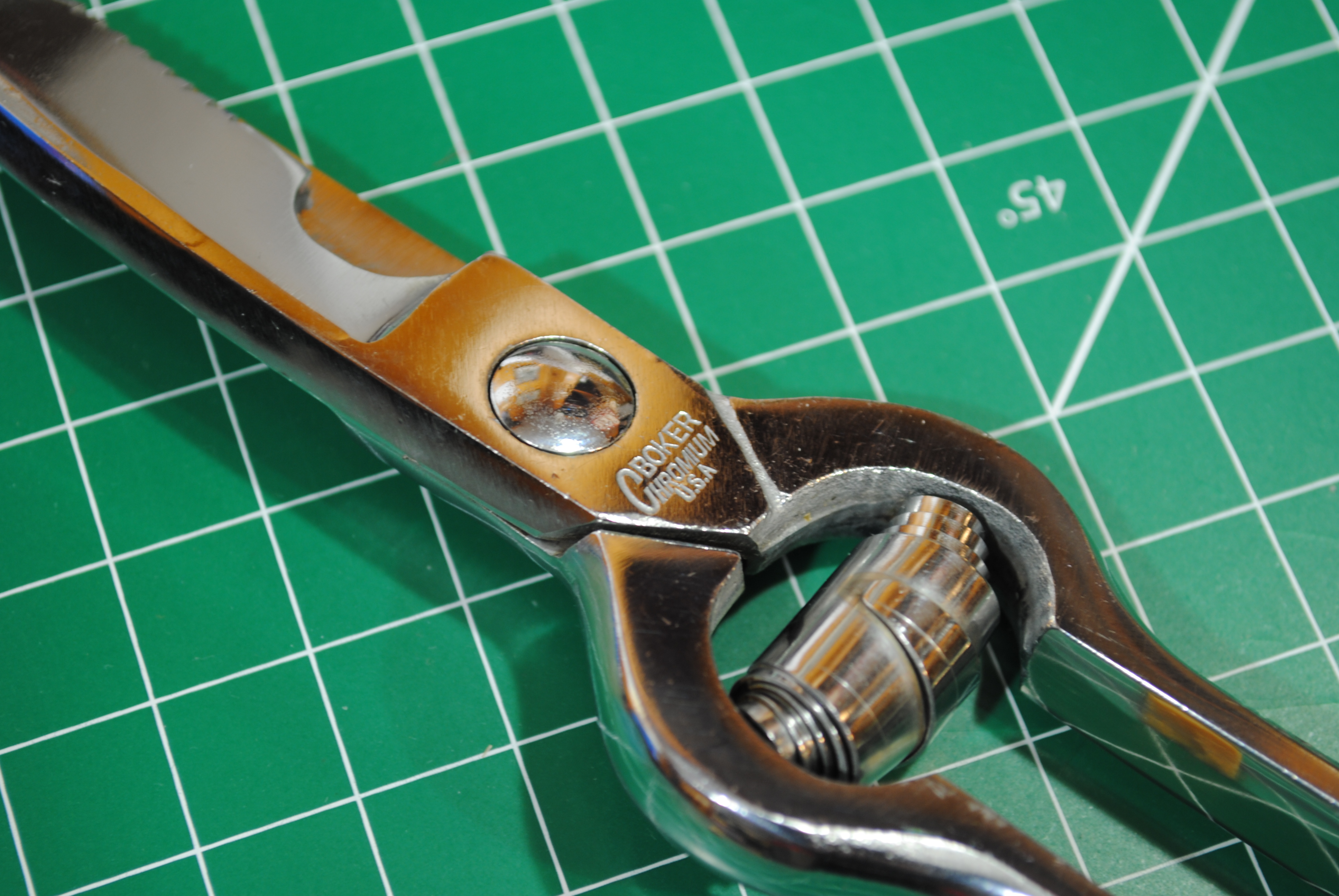
Guess what?  They are made by Boker in the USA.  Boker is an underappreciated knife line. 


Boker and Chromium


Böker traces its origin to the 17th century as a tool maker in Germany.  By the 1860s the company had fractured with a branch of the family emigrating to North America and setting up plants in Canada, New York, and Mexico. The German and North American factories produced similar knives and used the "Tree Brand" trademark. 


Boker Poultry Shears


WWII rolls up and we can’t have a German company operating in America.  The outcome, Boker America, no umlaut, is established.  During the war the Solingen factory was destroyed and "Boker USA" took control of the trademark until the German factory was rebuilt in the 1950s.  It’s difficult for me to understand, but even during war, business law rules.


In the 1960s and 1970s, the company changed hands several times, with the New York facility (Hermann Boker & Co) shutting down in 1983.  In 1986, Boker reacquired the rights to the American brand and Boker USA was started in Denver, Colorado for US production.  They also make knives in Germany, China and Argentina.


All three companies, Microtech, CRKT, and Boker make nice knives.  You owe it to yourself to check them out.

Monday, December 12, 2022

Christmas Presents

We had a water meter replacement, part of a sweeping urban trend to have transducers outside the house so meter readers can get data without entering the premises. I suspect there are safety issues involved.

My water meter is tucked away in a corner of the basement in a small hutch built by the original owners. The bottom part is enclosed and the upper has shelves on which I place knives and small flashlights. One side of the shelves, almost as an afterthought, has a small square of wood to cover the plumbing that feeds an outdoor faucet at the front side of the house. 

I had to move things around for the technician and afterward, before returning the clutter to its places, I decided to clean a little. Guess what I found? Are you fascinated by those stories on Facebook about people who find bags of money or valuable property hidden in their house? Secret rooms, hidden safes, tunnels that lead off into the darkness, so mysterious. Me, too! But I don’t believe them. If I discovered confederate gold in my basement, or piles of currency from the 50’s the last thing I would do is put it on the internet. 

What I did find was a folding ceramic blade knife with a plastic handle tucked behind a cold-water pipe on the 1X1 frame.

I remember buying this, but how did it end up hidden away?


 One shelf down I found a Stanley folding utility knife in a similar position.

A utility knife from my father-in-law, but no reason to keep it secret


What dark purpose were these knives used for and then hidden out of the light? 

 Beats me. I own both of them and have been wondering where the two of them have gotten. All I can figure is they got shoved behind the flimsy wood partition and ended up hidden. I did check a few other areas, just in case Jimmy Hoffa left some money, but no luck. 

The corner is so tight I couldn’t even photograph the knives in place. Drilling and running a small screw to secure the wood was difficult and I had to resort to using a mirror to get a semi-decent photo of the new screw. Still, I wonder. I have my suspicions on how the knives got back there, but I’ll never know for sure. 

Wait!  What's that shadow in the mirror?  Could it be......


Maybe this is more of a Halloween story, than Christmas.

Monday, December 5, 2022

Three Way

 You might be thinking about stocking stuffers and what cook can’t use a new utility knife?  Even if you’re not cooking from fresh products, you still have to open boxes, pouches and nothing works better than a knife.  Even that pizza you sent out for often needs a little cutting from a sharp knife to free it from the pie or, in polite company, cut it into fork-able sizes.


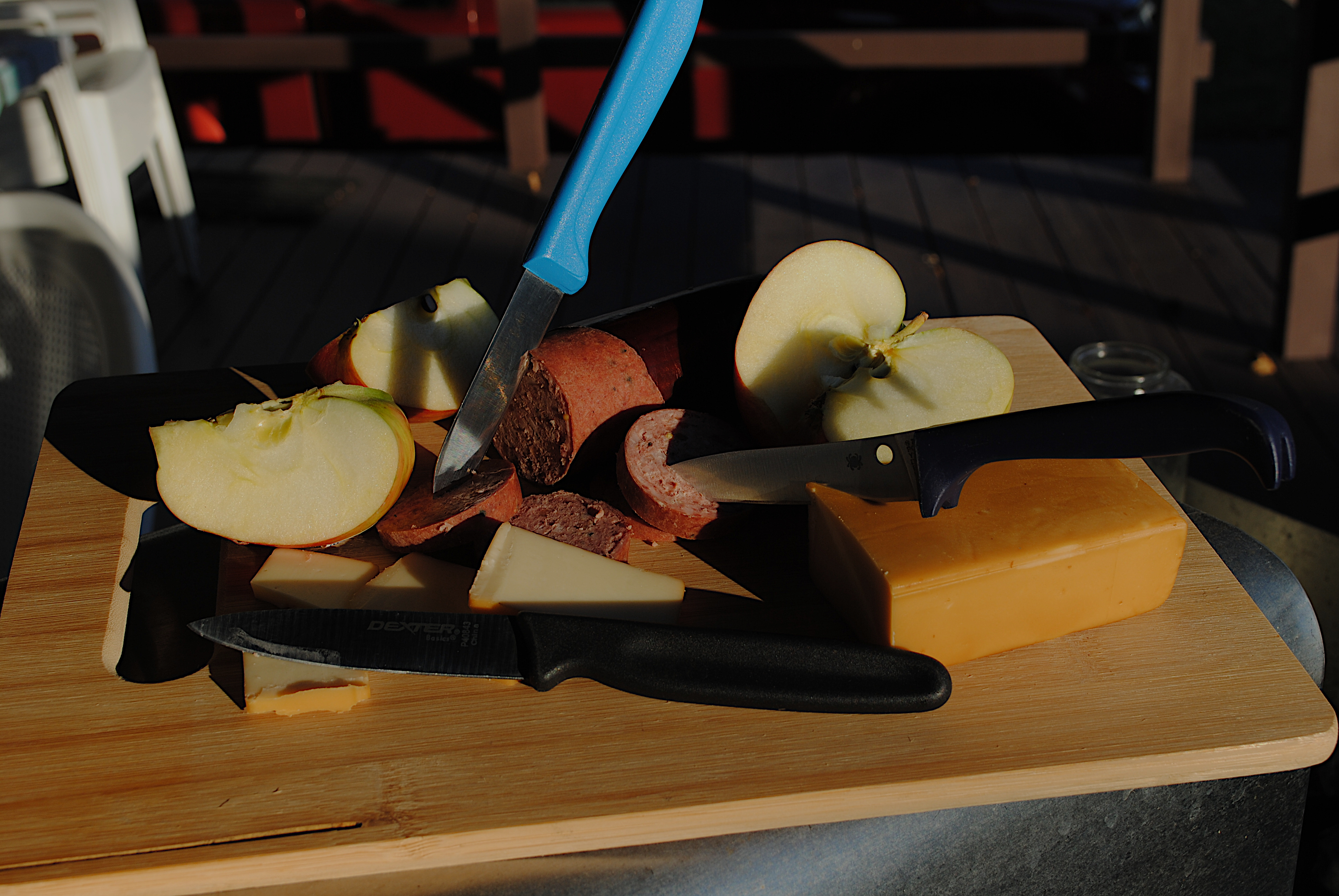
Three of my favorite kitchen paring knives

These knives are called utility or paring knives, and they are always a welcome gift.

My wife has several and I recently had a chance to work with a few.  Let me tell you what I found.


Zwilling J.A. Henckels Twin Master Parer

That's a mouthful.  Don't be confused by Henckels high-end semi-custom kitchen knives.  This is a little plastic handle kitchen worker.  The blade is 4 inches long and has a 4.25-inch plastic (polypropylene, I suspect) handle.  The blade is FRIODUR steel.  No, it is not the mystical steel seen in Lord of the Rings.  It is cryogenically treated 440C steel, which maximizes the blade's properties.  Now, 440C is the best of the 440 series and is a very economical steel with good properties. 


 Master Parer


The knife has a Wharncliffe blade anchored in a nice microtextured handle.  The blue polymer handle is shaped to provide a slight guard that flows into a reverse "S" shape, helping to lock the knife in your hand.  The blade's spine is slightly offset to the handle’s top or spine.  This little step makes a nice marker to determine where the blade stops and starts. 

After using the knife for a couple of weeks, I found the blade is holding its edge and remained sharp.  I like the way it feels in my hand.  The steel blade is the most flexible of these three, most likely due to its thinness.  Mine has the blade slightly bent from the handle.  I'm not concerned about that, yet.  All three of these knives are work tools; I expect they take a beating during normal use.  After three months of use, I'll have to see what it looks like.

You can find Twin Master Parer for under $14 without trouble.


It's no secret that I have a genuine affection for Spyderco.  There, it’s out in the open.  They have made kitchen knives on and off for years with different levels of success. 


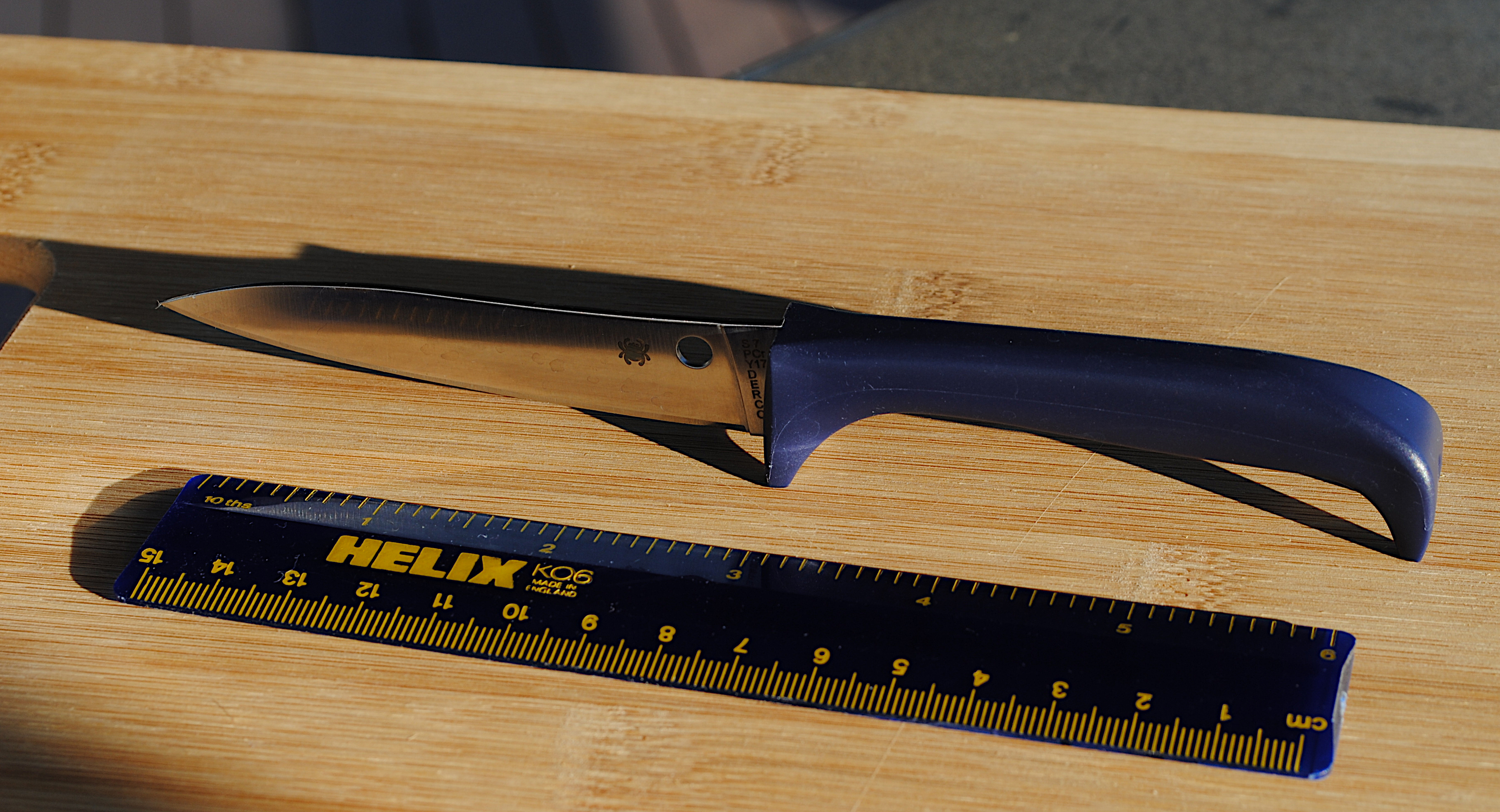
We have their Counter Puppy.  It’s a 7-inch-long knife with a 3.5-inch blade.  The blade steel is 7CR17, a Chinese stainless steel with good hardness, edge retention, and even better corrosion resistance.  The blade is a flat grind drop point with Spyder’s trademark hole.  Study the drop point blade and you will notice the blade’s spine has a gentle curve that softens the working appearance of the knife.


Counter Puppy


The blade edge has a slight curve that allows for a longer, flowing cut.  Since we’ve owned this knife the longest, I’ve sharpened it with my go-to sharpener, Spydie’s Sharpmaker. 

What is most noticeable are the ‘feet.’  The almost purple polymer handle has four feet arranged so you can put the knife down and the feet will hold it above the counter.  It’s a slick idea.  I’ve seen it before on pocket knives, but never in a kitchen knife.

The feet near the blade act as a terrific guard to protect your fingers.  The rear feet get in your way.  Look, I wear an X-large glove, and the knife handle is too short.  I've tried placing the rear feet between my little and ring finger, but it just doesn't work for my hand.  Spyderco could have achieved the unique look and kept the blade edge off the counter surface by eliminating the rear feet.

You can find your Counter Puppy for around $28 to $29.


The last up is the Dexter.

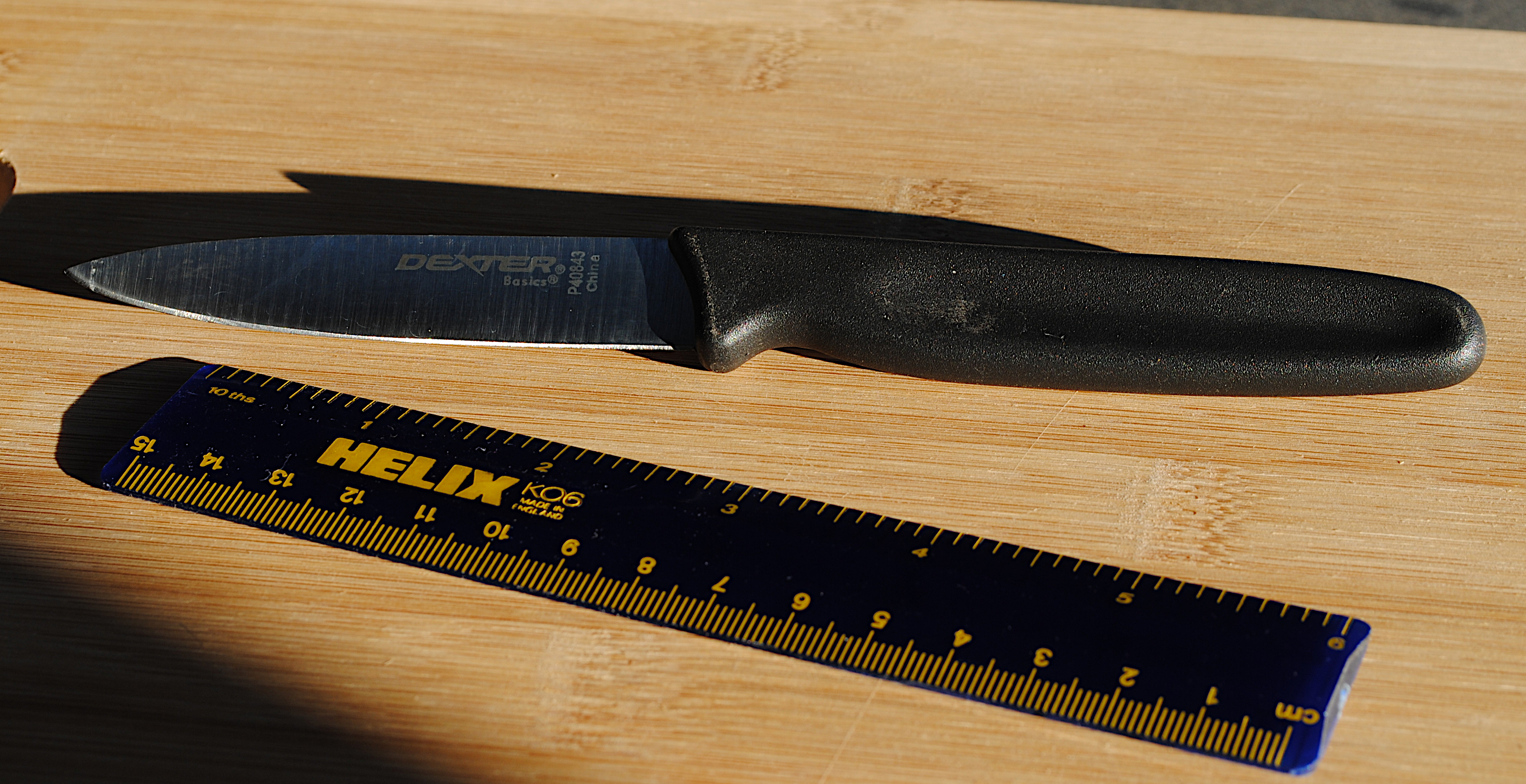
The manufacturer describes Dexter knives as a basic paring knives.  The blade is a thin, flat grind slice of a 400 series high carbon steel.  I suspect they mean 440C.  The drop point-shaped blade is 3.25 inches long with an almost 4-inch-long polymer handle.  The blade is relatively stiff.


 Dexter


The black handle (more polypropylene) has a finger indentation and a relatively deep and well-defined groove in the handle.  Both of which increase your grip.

It is by far the most basic kitchen knife of this group.  This is not a slam against the knife.  Function and form are related, and if form interferes with function, like the Counter Puppy's feet, you begin to move away from the utility nature of a paring knife.  A Dexter Basic Parer can be yours for $4.55.


Both the Spyderco Counter Puppy and Dexter Basic Parer are made in China.  The Twin Master Parer is made in Spain.  Nobody makes affordable, economical kitchen knives in America, so get over it.

My favorite?  Based on price and performance, it’s the Dexter.


But the one I grab is the Twin Master Parer.  It's newer, and sharper, and I like the feel and look and I'm willing to pay more for it.