Sunday, August 23, 2020

Boker's Pocket Knife

Mickey Yurco is an interesting fellow.  He’s been making knives for a number of years and has a number of unique concepts.  His current creation is a fixed blade knife he and Boker Knife call The Pocket Knife. 


Mickey's fixed blade "The Pocket Knife"

The first thing you notice when you open the box is the graceful saber grind drop point blade tapering to a point.  The egg-shaped handle is depressed by about 26 degrees from the center blade line.  More on that later.  The handle also sports a cutout that accommodates your index finger.  The egg-shaped handle is constructed of black G-10 and has a slight palm swell making it easy to grip the knife.  The upshot of this design is a knife that locks into your hand and the allows your wrist to be at its neutral position where you have the most strength and control of the knife.

Clearly it was a designed for a purpose. 

Let’s look at the specs, shall we?

The knife is made from 440C stainless steel.  The blade is 3.3 inches long with a 0.15 inch thickness and overall length of 6.8 inches.  The finger groove acts as a stop to keep your hand off the sharp edge.  The bend also helps to keep the knife from slipping forward or backward in your hand by converting either motion to a push into your palm or a press into your closed hand.  A large lanyard hole is available, always a good idea when working over water or deep snow.  

The knife seems to want to nessle deep into the palm of my hand

440C isn’t a super steel.  But it is the best of all the 440 steels.  It is also the steel everyone compares their newest steel to.  Frankly a well-made, well-tempered knife of 440C will give you all the performance the majority of us will ever need.

No discussion of steel is complete without a formula sheet:

440C contains:

  • 0.95-1.2% carbon
  • 16-18% chromium, 
  • 0.75 molybdenum,
  • 1.0 manganese and
  • 1.0 silicon.

 This formulation provides high strength, moderate corrosion resistance and good edge retention.  Some of the chromium and carbon form tiny carbides on the grain boundary.  Iron also can form carbides, but they are not as effective as chromium carbide.  These grains are very hard and resist the shear needed to displace the steel grains.  This is what gives steel its strength.

The remaining chromium forms a transparent thin film of chrome oxide that limits rust making the steel discolor or stain less.  Still an occasion drop of food grade oil is always a good idea.

The results of this chemistry and heat treatment gives The Pocket Knife a Rockwell hardness c scale of 57-58. 
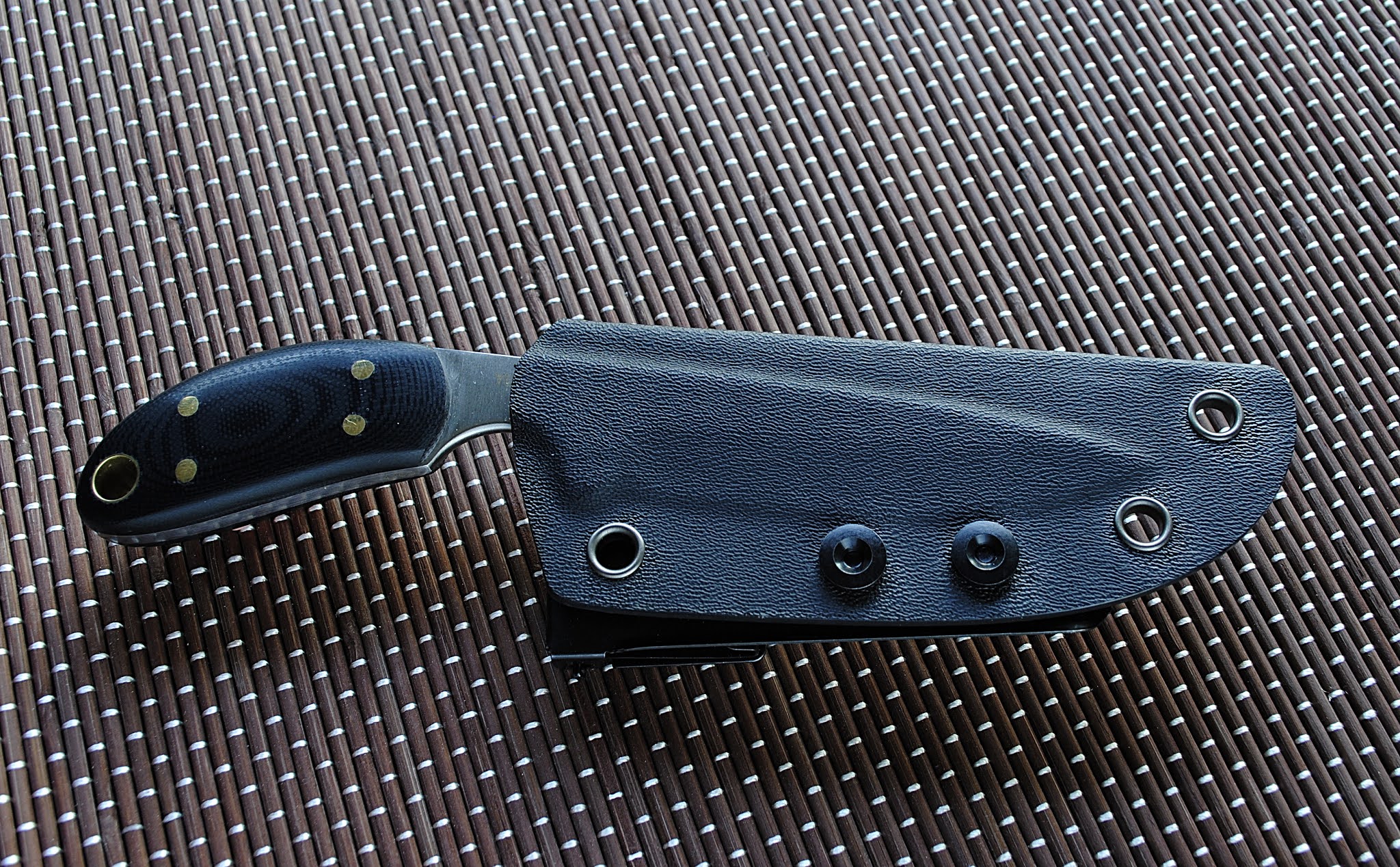
The sheath is made from strong light weight kydex

The sheath is fabricated out of kydex and sports what I think is a unique attachment device, the Ulticlip.  This clip allows you to fasten a variety of holsters and sheaths to pants without a belt.  The sheath slips into your pocket and locks on to the edge and provides a secure platform to draw the knife.  The knife sheath is designed so you can set it up for left or right pocket carry.  Mine arrived set up for left side.  I may leave it that way.


The Ulticlip is relatively new but quickly becoming a go-to solution for anchoring whatnots

The way back story.

Mickey has been seriously studying martial arts since the early 70s.  By 2000 he became interested in knife combatives as taught in Martial Blade Concepts.  Despite being in law enforcement, Mickey realized that even with CCW not everyone can carry a firearm, but most of us can carry a knife.  Mike Janich has developed an evolving concept of using a small legal knife for self-defense.  These concepts were attractive to Mickey and evolved into “The Pocket Knife.”  I’ll let Mickey tell you about it.


The wrist is in the neutral position and aligned with the long bones of the arm for maximum strength. 

“It was designed to be carried to the far right (just like my politics) of the front right pocket.  A fixed blade can be drawn and deployed faster than a folding knife.  Picture a normal stance with your thumbs in your pockets.  Your hand is now on the knife handle.  It is an inconspicuous way to quickly unsheath the knife. The small egg shaped handle fills the air pocket in the palm allowing a good grip.  The small handle also stays out of the way when not in use. This little blade is also a great shape for everyday mundane tasks from opening mail to cutting a steak at the Outback.  An email I received from Boker stated that it was a popular knife at a German Knife show.  I am pleased with their interpretation of my knife.”

I thought the knife needed to be a little lower in my pocket, so I moved the clip up one notch.  I like it lower in the pocket.  Yes, I will probably scratch the G-10 handle, but as I see it as a tool, I’m okay with that.


Sharp out of the box

I also did a little cutting with mine.  Cut a little rope, reduced cardboard to smaller pieces shaved a little wood.  I think it would make a great pork chop knife.  I’d take it for a walk off the concrete, for weekend at a cabin, or just simply heading out.

I think it’s a pretty cool knife.  Spend 5 minutes with Mickey and you’ll see how dangerous a knife can be in trained hand.  But even I know, that going up against someone with a couple inches of sharpened steel in their hand makes most people think twice.

You can get one for yourself for $60.00 at Boker.  Just follow the link: https://www.bokerusa.com/pocket-knife-02bo522

You can also find the Ulticlip to modify your current holsters, sheaths and whatnots at: https://www.ulticlip.com/?v=7516fd43adaa

Saturday, June 27, 2020

When it Rains.....


Ken Onion made his first knife in 1991 and hasn’t looked back.  He is a prodigious innovator holding 36 design patents on different items including locks, mechanisms, and knife designs.

Ken Onion Designed Rain Paring Knife


And frankly, I really love his designs.  So when I had the chance I picked up a kitchen knife from his Rain collection from Chef Works.  The instantly visible, the most striking aspect of the knife is the highly polished blade with a textured rain drop pattern.  Hence the name.  The pattern on the blade is designed to reduce food drag caused by surface tension and drag coefficient by creating multiple pockets of air.

Beats me.  I know drag coefficient is used in calculating friction forces which resist movement. I’m sure if you spent 8 hours a day cutting food, you’d want reduced food drag too!

Reverse paring knife
The blade is on top


The business end is a 3 inch reverse paring blade made from Carpenter’s DBZ-1 stainless steel.

DBZ-1 isn’t made from exotic elements.  The bulk of it is iron.  Carbon is between 0.6 and 0.75% with chromium falling in line with 12.5 to 15.3%.  There’s only 0.75% molybdenum  and a smattering of other elements.  The key to this martensitic steel is that it is designed to produce a network of fine carbide particles throughout the steel.  This produces a steel that takes a remarkable edge and holds it.

The most interesting part is the reverse edge.  The curved blade has the sharp, business edge on the top of the blade.  You need to be careful gripping the knife, because the finger grooves are on the opposite side from the edge.  I can’t tell you how many times I wanted to put my thumb on the razor sharp edge.  Just be real careful with this one.

They even warn you in the box.


The handle is shaped from G-10, a high-pressure fiberglass laminate.  It is made by stacking multiple layers of epoxy resin soaked fiber glass sheets and curing under high compression.  G-10 is the toughest of the glass fiber resin laminates.  It is almost indestructible.

This is a glamorous knife.  The blade catches the light and winks as you move it.  The handle with it’s finger grooves feel really good.  It was Blade magazine’s Kitchen Knife of 2013.
But you better watch that blade.  You may not shoot your eye out, but you’ll cut you finger off.


Monday, May 11, 2020

Bingham Knife

The knife caught my eye at a knife show and it came home with me.  But what did I get?  Well, it always starts with tang stamp and a reference book.  “W. Bingham Co  Cleveland O” was all I could read.

Mystery W. Bingham Knife


Cleveland at the turn of the 20 century had a glowing reputation as a hardware mecca.  There were four major distributors, one of which was The W. Bingham Co, which was one of the Midwest's largest hardware concerns.  It was founded when William Bingham and Henry Blosson bought out the hardware stock of Clark & Murfey in April 1841.

They opened their own store at Superior and W. 9th street and later expanded by erecting a new building nearby in 1855.  They also incorporated as the W. Bingham Co. in 1888.

In 1915, Bingham discontinued its retail operations and built a new wholesale warehouse at 1278 W. 9th St.  Although Bingham expanded its line of goods, its major business always remained hardware supplies and conducted business over 12 states. On 15 June 1961, Bingham closed its warehouse, but a group of Bingham officers, headed by Victor E. Peters, acquired the company's industrial division and renamed it Bingham, Inc.  Eventually the company stopped making industrial tools and became a distributor only.  Ownership traded hands with brokers and money managers and was finally bought by Formweld Products Co.  Some form of the company remains in operation in Solon where it continues to distribute tools to area manufacturers.

The blade has been polished but retains the rust pits.  The jog in the handle can be seen.

The first google reference I found was for a forged and fraudulent W. Bingham Co, knife. That didn’t give me any warm and fuzzy feelings.  The second was an Etsy ad for a $300 Bingham knife.  It was, as all Etsy products will tell you, rare and unique. 

A lot of distributors carried knives with their tang stamps which were made for them, not by them.  Cutlery companies exist to sell knives with your tang stamp.  One only has to look at early Spyderco’s made in Seki City.  Spyderco didn’t build a factory, they hired some to make it for them.  This is an honorable business practice, if properly identified.

Not a sealed end like doctor knives


As for the type of knife, well that’s still up for discussion.  It has squared butt, like a doctors, but it is pinned in place and not solid like a doctors knife.  About half way up the handle the entire handle takes a little jog sideways in the plane of the handle.  It’s not quite like a gunstock, because both sides jog and it’s a very small jog.  The main blade is a thin flat blade with a shallow false edge.  This style is often referred to as a long spear or physician blade.  The second blade is small despite the large channel it sits in.  Both blades open from the same end like a trapper, but the blade and knife handle are wrong, wrong, wrong for a trapper.  

Not a Trapper!


It’s like, in my unfounded opinion, you wrote up a description of what the knife should look like and someone else drew the sketch and made it.

The knife is lined with two brass side scales and a brass center scale.  The scale covers, I suspect, are a celluloid swirl of white and olive green.  Each blade has its own back spring. 

The blades have seen better days.  One of my common remarks is, if owners had just wiped down the metal surfaces with a drop of 3 in 1 oil… but they didn’t.  The blades and springs had rusted and someone scoured them rust free and ruined the collectable nature of the knife.  Even the back of the springs has been polished shiny.  As much as I hate rust, these scoured blades, so shiny and pitted just look wrong.  The defiler would have done better to just oil and carefully rub off the crusty rust and not gone after the pitted rust.

Each blade has it's own spring

I don’t think the knife was made by W. Bingham Co.  I think it was made for them.  It’s a link to Cleveland and part of the confusing history of knife making when companies were bought, sold, reacquired.  Today we expect some longevity in companies, but even that isn’t true.  New companies emerge and old names are sold.  Companies that were silent jobbers have launched their own brand using the experience they have gained making knives for other companies. Established companies use the excess capacity of smaller companies struggling to get a foothold, to boost their production or try out a new idea cheaply.  Names and brands are not guarantees if they were ever.

Monday, April 13, 2020

Treasures in the Drawer


I’m settled in for the next week at home.  I was cleaning a drawer and guess what?  I found two knifes I had almost forgotten about.

It was 1990 and I was reading Larry Niven’s Protector.  Larry represented the changes we experience in old age, due to a missing environmental agent, as an incomplete transformation to a superior being.  One of the attributes was skin so tough, so armored it could turn a bronze knife.  I wanted a bronze knife, but even bronze was expensive on my budget.

The bronze has tarnished a bit and it isn't very sharp, but at one time this was atomic bomb of the era

I was also interested in the Spanish navaja.  These are classic Spanish folding fighting and utility knives.  The classic knife used a set of pinion teeth which when opened produce a characteristic clicking sound.  Hence the nickname in some quarters, of cucaracha or cockroach.  Navajas came in many sizes and the larger ones were used for dueling.  It was said the sound of this knife opening in the darkness would make a brave man blanch.  Pretty cool, yes? 

Small navaja
Atlanta Cutlery made museum quality replicas and sold other knives as well.  Their catalog is part of a select group of magazines I call knife porn.  The color photos were great, as were descriptions of hard to find knives.  I used to dog ear pages to find my favorites faster.  Prices lists were the worst part.  One 1990 dollar had the purchasing power of $2.00 today.  

Still I found what I wanted: a small 1.75 inch bronze blade folder and a 3 inch blade navaja.

They originally had a ring attached to the pivot to open the lock.  that evolved in to the little metal tab.


The bronze bladed knife was described as a sandalwood folder costing $27 and the navaja priced in at $16.95.

I never used either.  Everyone swapped out their bronze weapons as soon as iron became available and even with the problem of rusting they were happy to do so.  I keep my bronze knife in a little caddy with cuff links.  It really belonged on a pocket watch chain.

The navaja was a disappointment.  Despite being made in Spain, it didn’t have the click and clacking noise I was interested in.  It too, doesn’t have a maker’s mark.

While now as a collector I am happy to own them, at the time it was one of many little lessons that wanting is sometimes better than owning.